Summary
Methodhub Software Limited, a Karnataka-based IT services and digital transformation company, is launching its ₹130.2 crore Initial Public Offering (IPO) in the SME segment from December 5-9, 2025. The company has demonstrated exceptional growth with 134% YoY revenue growth and 42% Return on Equity (ROE), positioning itself as a high-growth opportunity in India’s technology sector.
The Indian IPO market continues to witness strong participation from the technology sector, and Methodhub Software Limited is the latest entrant seeking to capitalize on investor appetite for IT services companies. This Karnataka-based digital transformation specialist is launching its Initial Public Offering (IPO) in the SME segment, offering investors an opportunity to participate in a high-growth technology venture. In this comprehensive analysis, we examine every aspect of the Methodhub Software IPO to help investors make informed decisions.
IPO Structure & Pricing
Methodhub Software Limited is coming to the market with a well-structured public offering designed to raise capital for expansion and debt reduction. Here’s the complete breakdown of the IPO structure:
Issue Size: ₹130.2 Crores
The IPO comprises:
- Fresh Issue Component: ₹87.5 Crores
- Offer for Sale (OFS): Balance amount
Price Band: ₹190 to ₹194 per equity share
The company has set a narrow price band, indicating confidence in its valuation. At the upper price band of ₹194, the company is seeking a post-issue market capitalization of approximately ₹365.76 crores.
Face Value: ₹10 per equity share
Issue Type: Book Built Issue in the SME segment
One noteworthy aspect is that despite being listed in the SME (Small and Medium Enterprises) segment, the issue size exceeds ₹100 crores, which is significantly larger than typical SME IPOs. This reflects the company’s substantial operations and growth trajectory, though it raises questions about why the company opted for SME listing rather than the mainboard.
Market Segment: NSE Emerge (SME Platform)
The listing will occur on the National Stock Exchange’s SME platform, which has specific listing requirements and trading mechanisms different from the main board.
IPO Timeline
Understanding the IPO timeline is crucial for investors planning to participate. Here are the key dates:
| Parameter | Details |
|---|---|
| Issue Size | ₹130.2 Crores |
| Fresh Issue | ₹87.5 Crores |
| Company Valuation | ₹365.76 Crores |
| Price Band | ₹190 – ₹194 per share |
| Lot Size | 600 shares |
| Minimum Investment | ₹1,16,400 (at lower band) |
| IPO Opens | December 5, 2025 |
| IPO Closes | December 9, 2025 |
| Allotment Date | December 10, 2025 |
| Listing Date | December 12, 2025 |
Note: This is an SME segment IPO, which is noteworthy given the substantial issue size exceeding ₹100 crores.
The IPO will remain open for 3 working days, providing ample time for investors to submit their applications. Investors should note that applying on the first day doesn’t provide any advantage in allotment, as the process follows a lottery system for retail investors if the issue is oversubscribed.
Cut-off Time: Applications can be submitted until 5:00 PM on the closing date through ASBA (Application Supported by Blocked Amount) facility.
Lot Size & Investment Requirements
The lot size and minimum investment are critical parameters that determine accessibility for retail investors:
Lot Size: 600 shares per lot
Minimum Investment:
- At lower price band (₹190): ₹1,14,000
- At upper price band (₹194): ₹1,16,400
Maximum Investment for Retail Investors:
- Maximum lots allowed: 2 lots (1,200 shares)
- Maximum investment: ₹2,32,800 (at upper price band)
Investment Multiple Table:
| Category | Lots | Shares | Amount at ₹194 |
|---|---|---|---|
| Retail (Min) | 1 | 600 | ₹1,16,400 |
| Retail (Max) | 14 | 8,400 | ₹16,29,600 |
| sHNI | 15+ | 9,000+ | ₹17,46,000+ |
| bHNI | As desired | As desired | ₹10,00,000+ |
Share Reservation
The IPO follows standard SEBI guidelines for share allocation across different investor categories:
| Category | Allocation | Minimum Shares |
|---|---|---|
| Retail Individual Investors (RII) | Up to 35% | Approximately 23.45 lakh shares |
| Non-Institutional Investors (NII) | Up to 15% | Approximately 10.05 lakh shares |
| Qualified Institutional Buyers (QIB) | Up to 50% | Approximately 33.5 lakh shares |
Retail Individual Investors (RII): Those applying for shares worth up to ₹2 lakhs fall in this category.
Non-Institutional Investors (NII): This category is further divided into:
- sHNI (Small HNI): Applications between ₹2 lakhs and ₹10 lakhs
- bHNI (Big HNI): Applications above ₹10 lakhs
QIB Category: Reserved for mutual funds, insurance companies, banks, and other institutional investors.
Employee Reservation: Details about any employee reservation quota have not been disclosed in the available information.
Company Overview
Methodhub Software Limited represents an emerging player in India’s rapidly expanding IT services sector, with a unique positioning that sets it apart from traditional service providers.
Incorporation & History:
- Founded in 2016, making it a relatively young company with 8+ years of operational experience
- Registered office located in Karnataka, one of India’s premier technology hubs
- Operates as a private limited company transitioning to public listing
Business Model:
Methodhub Software operates as a digital transformation partner, providing comprehensive IT solutions and infrastructure services to clients across diverse industries. Unlike many IT service companies that predominantly serve the Banking, Financial Services, and Insurance (BFSI) sector, Methodhub has deliberately diversified its client portfolio across multiple verticals.
Industry Diversification:
The company serves clients from:
- BFSI (Banking, Financial Services & Insurance): Traditional stronghold of IT services
- Oil & Gas and Energy Sector: Complex infrastructure requirements
- Healthcare & Life Sciences: Critical digital transformation needs
- Telecom & Tech Infrastructure: High-growth connectivity sector
- Automotive & Transport: Industry 4.0 implementation
- Innovation Technology & Consulting: Emerging tech solutions
This diversified approach reduces concentration risk and provides multiple growth avenues.
Geographic Footprint:
Methodhub operates internationally with presence in three key markets:
- Canada: Primary market contributing 40.08% of revenue
- United States: Second-largest market at 34.4% of revenue
- India: Domestic market contributing 25-26% of revenue
The strong international presence (approximately 75% of revenue from North America) demonstrates the company’s ability to compete globally and reduces dependence on the domestic market.
Service Delivery Model:
The company follows a hybrid service delivery model combining:
- Onsite services at client locations
- Offshore development centers in India
- Remote delivery capabilities enhanced post-pandemic
- Dedicated project teams for complex engagements
- Staff augmentation for specific skill requirements
Product Portfolio
Methodhub Software offers a comprehensive suite of IT services and infrastructure solutions. Understanding the revenue contribution from each service line provides insights into the company’s core competencies:
Revenue by Service Category
1. Data & AI Solutions (41.17% of revenue)
This is the company’s largest revenue generator, indicating strong positioning in one of technology’s fastest-growing segments. Services include:
- Data analytics and business intelligence
- Artificial intelligence and machine learning implementations
- Data warehousing and lake solutions
- Predictive analytics platforms
- Data migration and integration services
The 41% revenue contribution from Data & AI reflects market demand for data-driven decision-making capabilities.
2. IT Infrastructure Services (20.44% of revenue)
Traditional but essential infrastructure management services:
- Server management and optimization
- Network infrastructure design and implementation
- Infrastructure monitoring and maintenance
- Disaster recovery and business continuity planning
- Infrastructure as a Service (IaaS) solutions
3. Cloud Services (18.28% of revenue)
Cloud adoption continues accelerating, and Methodhub’s substantial cloud practice includes:
- Cloud migration services (lift-and-shift and re-architecture)
- Multi-cloud management (AWS, Azure, Google Cloud)
- Cloud security and compliance
- Cloud cost optimization
- Hybrid cloud solutions
4. Recruitment & Delivery Services (15-16% of revenue)
This staffing-related revenue stream includes:
- IT resource augmentation
- Contract staffing solutions
- Permanent placement services
- Specialized skill hiring
- Managed team services
This segment provides steady recurring revenue but typically operates at lower margins.
5. Bundled Services (6.62% of revenue)
Comprehensive solution packages combining multiple service offerings for integrated delivery.
6. Cybersecurity Services (Less than 4% of revenue)
Despite being a small contributor currently, cybersecurity represents a high-growth potential area:
- Security assessment and auditing
- Penetration testing
- Security operations center (SOC) services
- Compliance management
- Incident response services
7. ERP & CRM Solutions (0.08% of revenue)
Minimal contribution from enterprise software implementation, suggesting this is not a focus area.
Revenue by Service Type
From a different perspective, the company’s revenue splits into:
- IT Infrastructure Services: 79-80% of total revenue
- IT Services: 20-21% of total revenue
This indicates Methodhub is predominantly an infrastructure-focused company rather than a pure software services provider.
Revenue by Industry Vertical
Understanding client industry distribution helps assess risk concentration:
- IT Consulting: 24% (largest vertical)
- Healthcare & Life Sciences: 22%
- BFSI: 13.05%
- Automotive & Transport: 4.08%
- Oil & Gas: <4%
- Others: Balance revenue
The relatively balanced distribution across industries provides revenue stability and growth optionality.
Financial Performance (Consolidated)
FY 2024-25 vs FY 2023-24 Analysis
Methodhub Software has demonstrated exceptional financial performance, particularly over the last three fiscal years. Here’s a comprehensive breakdown:
Asset Base Growth:
- FY2023: ₹40 Crores
- FY2024: ₹45 Crores (12.5% growth)
- FY2025: ₹93 Crores (106% growth)
- H1 FY2026: ₹122 Crores (run-rate suggests continued expansion)
The dramatic asset base expansion in FY2025 indicates significant business scaling and capital deployment.
Revenue Performance:
| Period | Revenue (₹ Crores) | YoY Growth |
|---|---|---|
| FY2023 | 36 | – |
| FY2024 | 58 | 61.1% |
| FY2025 | 136 | 134.5% |
| H1 FY2026 | 80 | On track for ~₹160 Cr |
The revenue trajectory showcases hypergrowth, with FY2025 revenue more than doubling compared to FY2024. This 134% year-over-year growth is exceptional and significantly outpaces industry averages.
Profit After Tax (PAT) Performance:
| Period | PAT (₹ Crores) | YoY Growth |
|---|---|---|
| FY2023 | 1.34 | – |
| FY2024 | 5 | +273% |
| FY2025 | 11.5 | 130% |
| H1 FY2026 | 10 | On track for ~₹20 Cr |
The profit growth even exceeds revenue growth in percentage terms for FY2024, indicating operational leverage. In absolute terms, profits have grown 8.5x from FY2023 to FY2025.
EBITDA Performance:
While exact EBITDA figures weren’t disclosed in the transcript, based on the 12.61% EBITDA margin for FY2025:
- FY2025 EBITDA: Approximately ₹17.15 Crores
- This represents strong operational profitability
Operating Cash Flow:
A point of concern emerges here:
- Previously: Positive operating cash flow
- Currently: Negative operating cash flow
While this isn’t immediately alarming, it warrants monitoring. Negative operating cash flow during rapid growth can occur due to:
- Increased working capital requirements
- Faster revenue recognition vs. cash collection
- Investment in inventory or project costs
- Client payment cycles extending
However, sustained negative operating cash flow could indicate underlying collection or business model issues.
Debt Position:
- Current Borrowings: ₹39 Crores
At approximately 29% of FY2025 revenue and 3.4x PAT, this debt level appears manageable. The company plans to use IPO proceeds to reduce this burden.
Key Ratios (March 31, 2025)
Financial ratios provide crucial insights into operational efficiency, profitability, and shareholder returns:
Profitability Ratios
Gross Margin: 21%+
This indicates that for every ₹100 of revenue, the company retains ₹21+ after accounting for direct costs. For an IT services company, this is respectable, though not exceptional. The margin reflects:
- Competitive pricing pressure
- Mix of high-margin (consulting) and low-margin (staffing) services
- Offshore delivery benefits
EBITDA Margin: 12.61%
Earnings Before Interest, Tax, Depreciation, and Amortization (EBITDA) margin of 12.61% demonstrates solid operational efficiency. This compares favorably with:
- Industry average: 10-15% for mid-sized IT firms
- Large-cap peers: 15-20%
- SME IT companies: 8-12%
PAT Margin: 8.46%
Net profit margin of 8.46% reflects the company’s ability to convert revenue to bottom-line profit. This is healthy for a growing company, indicating:
- Efficient cost management
- Reasonable tax burden
- Manageable interest costs
Margin Trend Analysis:
The transcript notes that margins have been gradually declining as the company scales. This is typical during hypergrowth phases because:
- Companies invest heavily in sales and marketing
- New client acquisitions occur at competitive pricing
- Operational leverage takes time to realize
- Margins typically stabilize once scale is achieved
Return Ratios
Return on Equity (ROE): 42%+
This exceptional ROE indicates the company generates ₹42+ of profit for every ₹100 of shareholder equity. A 42% ROE is outstanding and significantly above:
- Industry average: 15-20%
- Market benchmark: 15%
- Blue-chip IT companies: 20-25%
High ROE suggests efficient capital utilization and strong business fundamentals.
Return on Capital Employed (ROCE): 25-26%
ROCE measures how efficiently the company uses all capital (equity + debt) to generate profits. At 25-26%, this indicates:
- Excellent capital productivity
- Strong competitive positioning
- Efficient asset utilization
- Better than most industry peers
Efficiency Ratios
While specific turnover ratios weren’t provided, the rapid revenue growth relative to asset base suggests strong asset turnover efficiency.
Valuation Metrics
Valuation is critical for IPO investment decisions. Let’s analyze Methodhub Software’s pricing:
Post-Issue Market Capitalization: ₹365.76 Crores
Price-to-Earnings (P/E) Ratio Calculation:
Based on FY2025 PAT of ₹11.5 Crores:
- P/E Ratio = 365.76 / 11.5 = 31.8x
Analysis: A P/E of 31.8x is moderate for a high-growth technology company showing 134% revenue growth and 130% profit growth. However, investors should compare this with:
Peer Comparison:
According to the transcript, Methodhub compares favorably with identified competitors:
- Smallest by revenue among peers
- Leading in EBITDA performance
- Leading in PAT performance
- Leading in ROE (42%+ vs. peers)
- Near-leading in ROCE
- Attractive P/E compared to peers, leaving listing gain potential
This suggests the IPO is reasonably priced relative to listed peers, potentially offering upside.
Price-to-Sales (P/S) Ratio:
Based on FY2025 revenue of ₹136 Crores:
- P/S Ratio = 365.76 / 136 = 2.69x
For comparison:
- Large-cap IT services: 3-5x
- Mid-cap IT services: 2-4x
- High-growth tech: 4-8x
The 2.69x P/S appears reasonable for the growth profile.
Price-to-Book (P/B) Ratio:
With ROE at 42%, investors can calculate implied book value:
- If PAT = ₹11.5 Crores and ROE = 42%
- Book Value = 11.5 / 0.42 = ₹27.4 Crores
- P/B Ratio = 365.76 / 27.4 = 13.4x
A 13.4x P/B is steep but justified by exceptional ROE.
EV/EBITDA Multiple:
- Enterprise Value = Market Cap + Debt = 365.76 + 39 = ₹404.76 Crores
- EBITDA (FY2025) = ₹17.15 Crores (estimated at 12.61% margin)
- EV/EBITDA = 404.76 / 17.15 = 23.6x
This is reasonable for a high-growth company.
Growth-Adjusted Metrics:
Given the 134% revenue CAGR, the:
- PEG Ratio (P/E to Growth) = 31.8 / 134 = 0.24
A PEG below 1.0 traditionally indicates attractive valuation relative to growth.
Use of Proceeds
Understanding how a company will deploy IPO capital is crucial for assessing management priorities and growth strategy:
Total Fresh Issue: ₹87.5 Crores
Allocation Breakdown:
1. Debt Repayment: ₹21.6 Crores (24.7% of fresh issue)
The company will use approximately one-quarter of proceeds to reduce its ₹39 crore debt burden. This will:
- Reduce interest expenses, improving profitability
- Strengthen balance sheet
- Improve credit rating
- Reduce financial risk
Post-IPO, debt would reduce to approximately ₹17.4 crores, representing a healthier 12-13% of revenue.
2. Capital Expenditure (Capex): ₹25 Crores (28.6% of fresh issue)
This significant allocation toward capex suggests plans for:
- Technology infrastructure upgrades
- Development center expansion
- Equipment and hardware purchases
- Software tools and platforms
- Office space expansion
The substantial capex allocation indicates management’s confidence in growth opportunities and need for capacity building.
3. Long-term Working Capital: ₹24 Crores (27.4% of fresh issue)
Working capital funding is essential for:
- Managing longer payment cycles from international clients
- Funding project costs before revenue recognition
- Supporting larger deal sizes
- Maintaining operational buffer during scaling
This allocation addresses the current negative operating cash flow concern.
4. Working Capital Management: ₹4 Crores (4.6% of fresh issue)
Additional working capital for day-to-day operations.
5. General Corporate Purposes & IPO Expenses: ₹12.9 Crores (14.7% of fresh issue)
This includes:
- IPO-related expenses (legal, merchant banking, printing, etc.)
- Marketing and brand building
- Strategic initiatives
- Potential unidentified acquisitions (mentioned in transcript)
The possibility of acquisitions is intriguing and could accelerate growth through:
- Technology acquisitions
- Client portfolio acquisitions
- Talent acquisitions
- Geographic expansion
Allocation Summary Chart:
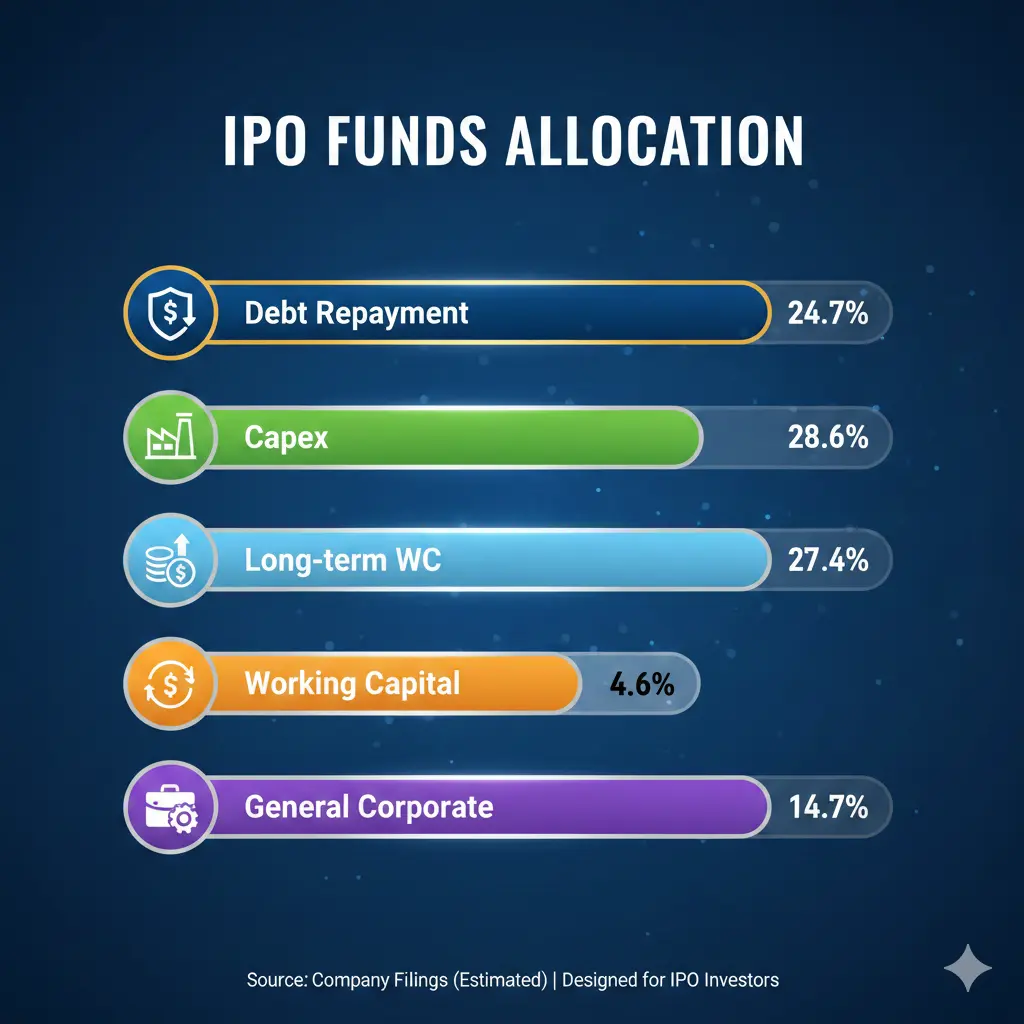
The allocation appears balanced and growth-oriented, with approximately 60% going toward expansion (capex + working capital) and 25% toward debt reduction.
Promoter Holding
Promoter holding is a critical indicator of management confidence and corporate governance:
Pre-Issue Promoter Holding: Specific percentage not disclosed in available documents
Post-Issue Promoter Holding: To be determined based on final issue structure
Lock-in Period: As per SEBI regulations for SME IPOs:
- Minimum promoter holding of 20% must be locked in for 2 years from listing
- Shares held beyond minimum 20% locked in for 1 year
Promoter Background:
While specific promoter details weren’t provided in the transcript, investors should examine:
- Promoters’ educational background and industry experience
- Previous entrepreneurial ventures
- Track record in technology sector
- Shareholding by individual promoters
- Related party transactions
Promoter Credibility Indicators:
- Company’s 8+ year operational history shows sustained commitment
- Consistent growth trajectory demonstrates execution capability
- International client base suggests global business acumen
Investors should review the Red Herring Prospectus (RHP) for detailed promoter information, including:
- Complete shareholding pattern
- Promoter entity details
- Any pledge or encumbrance on shares
- Criminal or regulatory proceedings, if any
Competitive Strengths
Understanding what differentiates Methodhub from competitors helps assess its sustainability and growth potential:
A. Exceptional Financial Performance
- Revenue CAGR exceeding 100% over three years
- PAT growing faster than revenue in recent years
- ROE of 42%+ significantly outperforms peers
- ROCE of 25-26% demonstrates capital efficiency
- Leading profitability metrics despite being smallest by revenue among peers
B. Diversified Industry Exposure
Unlike typical IT services firms heavily dependent on BFSI:
- Only 13% revenue from BFSI vs. 40-60% for many peers
- Strong presence in Healthcare (22%), IT Consulting (24%)
- Reduces concentration risk
- Provides multiple growth vectors
- Positions company to capitalize on sector-specific digital transformation waves
C. Strong International Presence
- 75% revenue from North America (Canada 40%, US 34%)
- Global delivery model with Indian cost advantages
- Currency diversification benefits
- Access to high-value projects
- Premium pricing potential in developed markets
D. High-Growth Service Focus
- 41% revenue from Data & AI (fastest-growing tech segment)
- 18% from Cloud Services (continuing secular growth)
- Minimal exposure to legacy technologies
- Positioned in future-focused service lines
E. Client Relationship Depth
While specific client metrics weren’t disclosed, the diversified revenue base suggests:
- Multiple client relationships rather than over-dependence on few accounts
- Cross-selling opportunities across service lines
- Recurring revenue potential
F. Operational Leverage
The company is entering a phase where:
- Fixed cost base is established
- Incremental revenue drops more directly to bottom line
- Margins can expand as scale increases
- Operating cash flow should turn positive
G. Management Execution Capability
The track record speaks volumes:
- Built ₹136 Cr revenue business in 8 years
- Successfully navigated COVID disruption
- Achieved international client acquisition
- Maintained profitability while scaling rapidly
H. Strategic Positioning
- Located in Karnataka (Bangalore ecosystem access)
- Talent availability in India’s tech capital
- Proximity to educational institutions for recruitment
- Ecosystem partnerships and networking opportunities
IPO Intermediaries
The credibility and track record of IPO intermediaries influence investor confidence:
Lead Merchant Banker
Track Record Analysis (based on transcript):
According to the review, the lead manager has:
- Overall track record: Described as “decent” (ठीक-ठाक)
- Recent performance: Last 2-3 IPOs have been “decent”
- Last two IPOs specifically: Delivered “quite solid performance” (काफी सॉलिड परफॉर्मेंस)
- This year’s overall performance: “Not very good track record” but improving
Interpretation: The lead manager appears to be in an improvement phase, with recent IPOs performing better than earlier ones. While not a top-tier merchant banker, the improving trend is positive.
Due Diligence Recommendation: Investors should independently verify:
- Lead manager’s complete IPO track record
- Average listing gains from managed IPOs
- Post-listing performance (3-month, 6-month returns)
- Any regulatory actions or penalties
Registrar to the Issue
The registrar handles:
- Application processing
- Allotment decisions
- Refund processing
- Demat credit
- Investor grievance handling
Investors should note registrar details from the prospectus for post-issue correspondence.
Legal Advisors
Legal counsel ensures:
- Regulatory compliance
- Proper documentation
- Due diligence completion
- Risk disclosure adequacy
Other Intermediaries
- Auditors: Verify financial statements and provide certification
- Bankers to the Issue: Handle IPO funds and refunds
- Underwriters: May underwrite the issue (if applicable)
Expert Opinion
Should You Subscribe?
Comprehensive Investment Perspective
Strong Points for Subscription:
- Hypergrowth Trajectory: 134% revenue growth and 130% profit growth are exceptional
- Outstanding ROE: 42% ROE is rare and indicates exceptional business quality
- Reasonable Valuation: P/E of 31.8x for 130%+ growth (PEG of 0.24) appears attractive
- Diversified Revenue: Industry and geographic diversification reduces risk
- High-Growth Segments: Focus on Data & AI and Cloud positions company well for future
- Profitability: Unlike many growth companies, Methodhub is solidly profitable
- Competitive Edge: Leading peers in multiple profitability metrics despite smaller size
- Listing Gain Potential: Valuation vs. peers suggests room for appreciation
Risk Factors to Consider:
- SME Platform Concerns: ₹100+ Cr issue on SME platform is unusual; why not mainboard?
- Liquidity Constraints: SME stocks typically have lower trading volumes
- Operating Cash Flow: Negative OCF needs monitoring and improvement
- Margin Compression: Declining margins during growth phase, though expected
- Small Scale: At ₹136 Cr revenue, company is vulnerable to competition from larger players
- Client Concentration: No disclosure on top client contribution (could be risk if concentrated)
- Limited History: Only 8 years of operations vs. decades for established peers
- Lead Manager Track Record: Mixed record doesn’t inspire high confidence
- High Minimum Investment: ₹1.16 lakhs may limit retail participation and liquidity
- Execution Risk: Can company maintain 100%+ growth rates? History suggests most can’t
Investment Suitability
Suitable For:
- Aggressive investors with high risk appetite
- Those believing in India’s IT services growth story
- Investors comfortable with SME platform constraints
- Long-term holders (2-3 year horizon minimum)
- Portfolio players seeking exposure to Data/AI segment
Not Suitable For:
- Conservative investors
- Those seeking stable, dividend-paying stocks
- Short-term traders (though listing gains possible)
- Investors uncomfortable with volatility
- Those unable to tie up ₹1.16 lakhs minimum
Rating Framework
On a subscription rating scale:
🌟🌟🌟🌟 (4/5) – SUBSCRIBE with Caution
Rationale: Strong fundamentals, exceptional growth, reasonable valuation, and solid profitability justify subscription. However, SME platform, negative operating cash flow, and execution risks prevent a full 5-star rating.
Allocation Strategy Recommendation
Given the risk-reward profile:
- Aggressive Allocation: 2 lots (₹2.32 lakhs) for maximum retail exposure
- Moderate Allocation: 1 lot (₹1.16 lakhs) for balanced risk
- Conservative Approach: Avoid or wait for listing to assess market reception
Post-Listing Strategy
If allotted:
- Listing Day: Consider booking 30-40% profit if strong listing gains (20%+)
- Hold Remaining: Retain for medium term (1-2 years) to participate in growth story
- Stop Loss: If stock falls 15-20% below issue price post-listing, reassess fundamentals
- Addition Strategy: If business continues performing, add on dips for long-term wealth creation
15. Important Disclaimers & Investment Advisory
Critical Investment Reminders
🚨 This is NOT Investment Advice: This analysis is for educational and informational purposes only. It does not constitute:
- Investment advisory services
- Buy/sell/hold recommendations
- Personalized financial planning
- Legal or tax advice
Consult Professionals: Before investing, ALWAYS consult with:
- SEBI-registered investment advisors
- Certified financial planners
- Tax professionals for tax implications
- Legal advisors if needed
Personal Due Diligence: Investors MUST:
- Read the Red Herring Prospectus completely
- Understand all risk factors disclosed
- Verify all financial information independently
- Assess personal risk tolerance and financial goals
- Only invest surplus funds you can afford to lose
IPO Investment Risks:
- No guarantee of allotment: Oversubscribed IPOs use lottery
- Listing loss possible: Price may list below issue price
- Lock-in for investors: None for retail, but liquidity may be limited
- Market risk: Overall market conditions affect performance
- Company-specific risks: Business may not perform as expected
SME Platform Specific Risks:
- Lower liquidity compared to mainboard
- Higher volatility in price movements
- Less stringent disclosure requirements
- Smaller analyst coverage
- Higher risk-return profile
Risk Disclosure
Market Risks: Stock market investments are subject to market risks. Past performance is not indicative of future results. The value of investments can go down as well as up.
Company-Specific Risks:
- Technology obsolescence
- Client concentration
- Competition intensification
- Regulatory changes
- Currency fluctuation (given international revenue)
- Key personnel dependency
- Cybersecurity threats
IPO-Specific Risks:
- Overvaluation at issue price
- Poor post-listing performance
- Management quality uncertainties
- Limited trading history
Contact Information for IPO
For official information:
- Company Website: Check RHP for official website
- Registrar Contact: Details in prospectus
- Investor Grievances: Company Secretary contact in RHP
- SEBI SCORES: For complaints – scores.gov.in
Stay Updated
For latest IPO updates, GMP (Grey Market Premium), subscription status, and allotment information:
Remember: Investment decisions should be based on your financial goals, risk appetite, and due diligence—not on any single expert opinion or review.
Disclaimer: This article is for educational and informational purposes only. It does not constitute financial advice or investment recommendation. Investors should conduct their own research and consult with certified financial advisors before making investment decisions. IPO investments carry market risks. Past performance does not guarantee future results. Also The Content is AI generated but check by our content writers. If you have any wrong information or facts, please feel free to contact us.