The Indian stock market is about to witness another significant debut from the logistics sector. Shadowfax Technologies, a company that’s been quietly powering millions of deliveries across India, is opening its Initial Public Offering (IPO) for subscription. But should you invest? Let’s break down everything you need to know about this offering.
What is Shadowfax Technologies?
Shadowfax Technologies operates as a third-party logistics (3PL) provider, specializing in what the industry calls “last-mile delivery.” Think of them as the invisible force behind your Zomato dinner, your Flipkart package, or that urgent medicine delivery from a quick commerce app.
Founded in 2015, the company has built a massive delivery network spanning 14,758 pin codes across India. They work with over two lakh delivery partners to ensure your orders reach your doorstep, especially that challenging final 5-10 kilometers that many companies prefer to outsource.
Their client roster reads like a who’s who of Indian e-commerce: Meesho, Flipkart, Swiggy, Zomato, and Uber, among others. This diverse client base positions them uniquely as the only third-party logistics provider operating across end-to-end delivery, last-mile delivery, food delivery, and hyperlocal delivery segments.
IPO Details and Issue Size
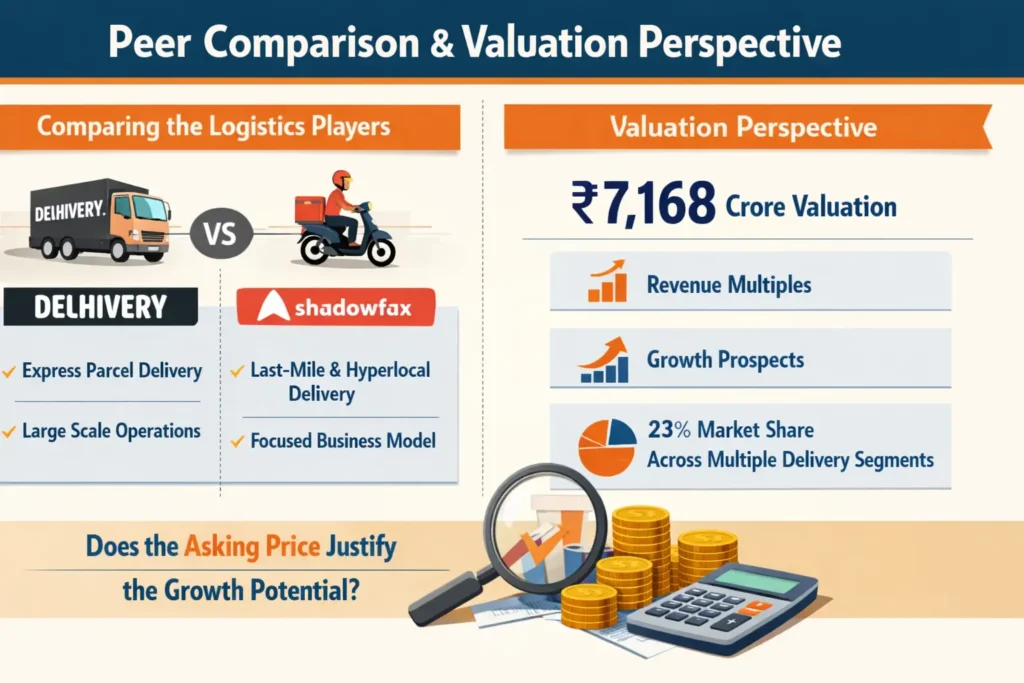
The Shadowfax Technologies IPO comes with a total issue size of ₹1,907 crore. The price band has been set between ₹118 and ₹124 per share, valuing the company at approximately ₹7,168 crore at the upper price band.
The issue comprises two components. A fresh issue worth ₹1,000 crore will bring new capital into the company. The remaining ₹907 crore is an offer for sale (OFS), where existing institutional investors like Flipkart, Mirae Asset, NewQuest, and Eight Roads are partially exiting their positions.
The IPO opens for subscription on January 21, 2025, and closes on January 22, 2025.
How Will the Company Use IPO Proceeds?
According to the Draft Red Herring Prospectus (DRHP), Shadowfax has earmarked the fresh capital for specific purposes. ₹423 crore will go toward capital expenditure for network infrastructure expansion. Another ₹350 crore is allocated for general corporate purposes and potential acquisitions.
The company also plans to use IPO proceeds for lease payments on new first-mile, last-mile, and sorting centers—critical infrastructure for maintaining their delivery network. A portion will also address working capital requirements, which is particularly important in the cash-intensive logistics business.
Read Also – How to Withdraw Your EPF via UPI: Complete Implementation Guide for 2026
Financial Performance: The Numbers Tell a Story
Shadowfax’s financial trajectory shows impressive revenue growth but reveals the harsh reality of logistics economics. In FY24, the company posted revenues of ₹1,884 crore. By the first half of FY26 alone, they had already matched that entire year’s revenue.
However, profitability tells a different story. Despite generating ₹2,485 crore in revenue during FY25, the company earned just ₹6.4 crore in net profit—a margin of barely 0.25%. The first half of FY26 showed improvement with ₹21 crore profit on similar revenues, but margins remain razor-thin.
This isn’t unique to Shadowfax. Competitor Delhivery, which recently listed on the stock exchanges, earned ₹162 crore profit in FY25 from revenues of ₹8,932 crore—also reflecting the industry’s challenging margin profile.
Market Position and Growth Potential
The company holds approximately 23% market share in the third-party logistics segment as of FY25, according to industry reports. This represents remarkable growth from just 8% market share in FY22—nearly a threefold increase in three years.
This growth trajectory aligns with India’s booming e-commerce sector. The online retail market is projected to grow at 20-25% CAGR between 2025 and 2030, according to industry analysts. Quick commerce, where Shadowfax has significant exposure, is expected to grow even faster at 50-62% during the same period.
With India’s consumer base of 1.5 billion people and an expanding middle-income household segment, the logistics infrastructure supporting this consumption needs to scale proportionately. E-commerce logistics alone handled between 4.9 to 5.3 billion shipments in FY25.
The Technology Advantage
Shadowfax operates through proprietary technology platforms that handle the complex orchestration of millions of deliveries. Their in-house logistics management system manages routing, real-time tracking, automated payouts, and dispute resolution.
The company has also developed specialized systems: Frodo for partner management, SF Shield for fraud detection, and SF Maps for address intelligence. These technological investments create economies of scale—the cost of maintaining these systems doesn’t increase proportionately with delivery volumes, giving larger players a structural advantage.
Key Risk Factors Investors Should Consider
Customer Concentration Risk
One concerning aspect is revenue concentration. Nearly 49% of Shadowfax’s revenue in H1 FY26 came from a single client. The top ten clients collectively contribute about 84% of total revenues. This creates significant dependency—any pricing renegotiation or client loss could materially impact financial performance.
Thin Profit Margins
As demonstrated by the financials, logistics remains a low-margin business. Even at scale, companies struggle to achieve healthy profitability. This makes the business vulnerable to any operational disruptions, fuel price increases, or regulatory changes affecting gig workers.
Working Capital Intensity
Logistics operations require significant working capital. Delivery partners and vendors need upfront payments, while collections from large platform clients often come later. As business volumes grow, this cash gap widens, creating constant pressure on liquidity.
Gig Economy Regulatory Uncertainty
Shadowfax operates with over two lakh delivery partners, all engaged through the gig economy model with no exclusive arrangements. Any tightening of gig-worker regulations, mandatory social security provisions, or minimum wage requirements could significantly impact operational costs and margins.
Seasonal Demand Volatility
The business experiences sharp peaks during festive sales and promotional periods, followed by slower quarters. However, infrastructure and manpower can’t be easily scaled up or down, creating a mismatch between fixed costs and variable revenues.
Read Also – HDFC Bank Q3 Results: Why Profit Is Growing But Margins Tell a Different Story
Peer Comparison and Valuation Perspective
The Investment Perspective
The Shadowfax Technologies IPO isn’t merely a bet on whether Indians will continue shopping online—that trend appears well-established. Instead, it’s fundamentally a bet on whether third-party logistics can be organized profitably at scale.
The company’s strengths include its diversified delivery capabilities, strong technology infrastructure, and growing market share. The relationships with major e-commerce platforms provide steady volume, and the expanding quick commerce sector offers additional growth opportunities.
However, the structural challenges are equally significant. Thin margins leave little room for error. High customer concentration creates vulnerability. Working capital requirements will continue as the business scales. And the gig economy model faces potential regulatory headwinds.
Final Thoughts
For retail investors considering this IPO, the decision should align with your risk appetite and investment horizon. Shadowfax operates in a growing sector with strong tailwinds, but profitability at scale remains challenging across the industry.
Those comfortable with early-stage growth stories in capital-intensive sectors might find value here. Conservative investors might prefer waiting for a few quarters of listed performance to better assess how the company navigates competitive pressures and margin challenges.
As always, consider your portfolio allocation, conduct thorough due diligence, and consult with a SEBI-registered financial advisor before making investment decisions. The logistics sector offers tremendous growth potential, but selecting the right player at the right valuation makes all the difference.
Disclaimer: This article is for informational purposes only and should not be considered investment advice. Please conduct your own research or consult with a certified financial advisor before making investment decisions.
News Source – SEBI