Quick Summary: Vidya Wires Limited, a Gujarat-based copper and aluminum wire manufacturer established in 1981, is launching its ₹300 crore IPO from December 3-5, 2025. The company operates in the winding and conductivity products segment with over 8,000 SKUs, serving critical industries like energy generation, electric mobility, and railways. Trading at a significantly discounted valuation compared to peers, the IPO presents both opportunities and concerns. Key positives include 94% repeat customer revenue, 25% revenue growth, and 59% PAT growth in FY25. However, investors should note the negative operating cash flows, promoter background issues (SEBI settlement), and the impending entry of Adani and Birla groups into the wiring segment. The issue is priced at ₹48-52 per share with a minimum investment of ₹14,976 for retail investors.
IPO Structure & Pricing
Vidya Wires Limited is coming to the capital markets with a well-structured public offering designed to fuel its expansion plans while providing an exit opportunity to existing shareholders.
Issue Composition
| Component | Details | Amount (₹ Crores) |
|---|---|---|
| Total Issue Size | 5.77 crore shares | ₹300.01 |
| Fresh Issue | 5.27 crore shares | ₹274.00 |
| Offer for Sale (OFS) | 0.50 crore shares | ₹26.01 |
| Face Value | Per equity share | ₹1 |
| Price Band | Per share | ₹48 – ₹52 |
| Issue Type | Book Building Process | Mainboard IPO |
The IPO structure reveals that approximately 91% of the total proceeds will come from fresh capital infusion, which will directly strengthen the company’s balance sheet. Only 9% represents an offer for sale, indicating minimal dilution pressure from existing shareholders. This is a positive sign as it shows promoters’ confidence in the company’s long-term prospects.
Pre and Post Issue Share Capital
| Parameter | Pre-IPO | Post-IPO | Dilution |
|---|---|---|---|
| Total Shares | 16.00 crore | 21.27 crore | 32.93% |
| Promoter Holding | 99.91% | TBD | – |
The equity dilution of approximately 33% is reasonable for a growth-oriented company looking to expand its manufacturing capacity and reduce debt burden.
IPO Timeline
Planning your investment requires understanding the critical dates associated with the Vidya Wires IPO. Here’s the complete schedule:

Important Points to Remember
The subscription window is open for only 3 working days, which is standard for mainboard IPOs. Retail investors using UPI payment mechanism must ensure their mandate is confirmed before 5 PM on December 5, 2025. Failure to do so will result in automatic rejection of the application.
The relatively quick turnaround time from closure to listing (5 days) means investors can expect faster deployment of capital compared to some other IPOs that take 7-10 days for listing.
Lot Size & Investment Requirements
Understanding the lot size structure is crucial for planning your investment amount and category-wise allocation strategy.
Retail Individual Investors (RII)
| Application | Lots | Shares | Amount at ₹52 |
|---|---|---|---|
| Minimum | 1 | 288 | ₹14,976 |
| Maximum | 13 | 3,744 | ₹1,94,688 |
Retail investors can apply for a minimum of 1 lot (288 shares) requiring an investment of ₹14,976 at the upper price band. The maximum application limit is capped at 13 lots to ensure wider distribution among retail participants.
Small High Net-Worth Individuals (sHNI)
| Application | Lots | Shares | Amount at ₹52 |
|---|---|---|---|
| Minimum | 14 | 4,032 | ₹2,09,664 |
| Maximum | 66 | 19,008 | ₹9,88,416 |
Small HNIs must invest a minimum of ₹2.10 lakhs, which represents applications above the retail limit but below ₹10 lakhs.
Big High Net-Worth Individuals (bHNI)
| Application | Lots | Shares | Amount at ₹52 |
|---|---|---|---|
| Minimum | 67 | 9,296 | ₹10,03,392 |
Big HNI category starts at an investment exceeding ₹10 lakhs, allowing institutional and wealthy investors to participate with larger ticket sizes.
Key Investment Insights
The lot size of 288 shares is relatively standard and makes the IPO accessible to small retail investors. At ₹14,976, the minimum investment is affordable compared to several recent IPOs that required ₹20,000-30,000 minimum investment. This lower entry barrier could drive higher retail participation.
Share Reservation
The allocation structure determines how shares are distributed among different investor categories.
| Investor Category | Allocation | Lock-in Period |
|---|---|---|
| Qualified Institutional Buyers (QIB) | Not more than 50% | No lock-in |
| Retail Individual Investors (RII) | Not less than 35% | No lock-in |
| Non-Institutional Investors (NII) | Not less than 15% | No lock-in |
| Employee Reservation | If applicable | As per SEBI norms |
Understanding Allocation Dynamics

What This Means for You:
- Retail investors have the best chance of getting full allotment if they apply for 1 lot
- Higher lot applications (10-13 lots) may receive partial or no allotment in oversubscribed scenarios
- QIB and NII categories compete in their respective buckets
Company Overview
Vidya Wires Limited boasts a rich legacy spanning over four decades in the copper and aluminum wire manufacturing industry.
Company Foundation
| Parameter | Details |
|---|---|
| Incorporation Year | 1981 |
| Company Name | Vidya Wires Limited |
| Headquarters | Anand, Gujarat, India |
| Industry | Wire Manufacturing (Copper & Aluminum) |
| Business Segments | Winding Wires, Conductivity Products |
| Manufacturing Capacity (Current) | 19,680 MT per annum |
| Planned Capacity | 37,680 MT per annum |
| Expansion Location | Narsanda, Gujarat |
| Product Range | 8,000+ SKUs |
Business Model
Vidya Wires operates in the specialized B2B segment, manufacturing precision-engineered winding and conductivity products. The company serves as a critical supplier to industries requiring high-quality copper and aluminum wires for applications demanding superior conductivity, durability, and thermal efficiency.
Strategic Positioning
The company has positioned itself uniquely by offering an extensive product range under one roof. With over 8,000 Stock Keeping Units (SKUs) ranging from wire diameters of 0.07mm to 25mm, Vidya Wires caters to diverse customer requirements across multiple end-user industries.
Manufacturing Footprint
Currently operating at 19,680 metric tons per annum (MTPA) capacity, the company is undertaking a significant expansion project to add 18,000 MTPA, which will nearly double the total capacity to 37,680 MTPA. This expansion is being set up at Narsanda, Gujarat, strategically located to serve major industrial corridors in Western India.
Workforce
| Employee Category | Numbers (as of Nov 14, 2025) |
|---|---|
| Permanent Employees | 139 |
| Contract Laborers | 394+ |
| Total Workforce | 533+ |
The lean permanent workforce supplemented by contract labor provides operational flexibility and cost optimization—a common practice in manufacturing sectors with seasonal demand variations.
Future Product Pipeline
The company plans to diversify into new product categories including:
- Copper foils for advanced applications
- Solar cables for renewable energy sector
- Aluminum winding wires for cost-effective solutions
This product expansion aligns with India’s growing focus on electric mobility, renewable energy, and infrastructure development.
Product Portfolio
Vidya Wires has developed a comprehensive product portfolio serving critical industrial applications across multiple sectors.
Core Product Categories
| Product Type | Applications | Key Features |
|---|---|---|
| Enameled Copper Winding Wires | Motors, transformers, generators | High conductivity, thermal resistance |
| Enameled Copper Rectangular Strips | Large transformers, heavy machinery | Space-efficient winding |
| Fibre Glass Covered Conductors | High-temperature applications | Enhanced thermal protection |
| Paper Insulated Conductors | Transformers, electrical equipment | Traditional insulation method |
| PV Ribbons | Solar panels | Optimized for photovoltaic cells |
| PV Bus Bars | Solar energy systems | Efficient power collection |
| Copper Busbars | Power distribution | Low resistance, high current capacity |
| Cotton Covered Ropes | Specialized applications | Flexible insulation |
Industry-Wise Revenue Distribution (FY 2024-25)
| End-User Industry | Revenue Contribution | Growth Potential |
|---|---|---|
| Power Generation & Transmission | 48.06% | Moderate-High |
| Electrical Mobility & Transmission | 28.88% | Very High |
| Electrical Systems | 10.00% | Moderate |
| General Engineering | ~10.00% | Moderate |
| Renewable EV & Automotive | ~10.00% | Very High |
| Consumer Durables | 2-3% | Low-Moderate |
Key Industry Applications
Energy Generation & Transmission (48% Revenue): This remains the largest revenue contributor. Products are used in transformers, generators, and transmission equipment essential for India’s growing power infrastructure. With the government’s push for 500 GW renewable energy capacity by 2030, this segment offers stable long-term growth.
Electric Mobility & Electrical Transmission (29% Revenue): The second-largest segment benefits from India’s electric vehicle revolution. Winding wires are crucial components in EV motors, charging infrastructure, and related electrical systems. The government’s FAME II scheme and state-level EV policies are driving demand.
Railway Applications: Indian Railways’ electrification drive (100% electrification target) and metro expansion in tier-1 and tier-2 cities create sustained demand for specialized wiring products.
Clean Energy Sector: PV ribbons and busbars cater to the rapidly expanding solar energy market. India’s solar capacity additions of 10+ GW annually provide a growing addressable market.
Geographic Distribution
| Market | Revenue Share | Strategy |
|---|---|---|
| Domestic Sales | 86% | Deepening penetration |
| Export Sales | 14% | Diversification focus |
The 86:14 domestic-export split indicates strong home market focus with emerging international presence. The 14% export revenue suggests quality standards meeting international requirements.
Customer Retention Metrics
One of the most impressive aspects of Vidya Wires’ business model is its 94% repeat customer revenue. This exceptionally high repeat rate indicates:
- Superior product quality and consistency
- Strong customer relationships
- Switching costs for customers
- Reliable supply chain and delivery
- Competitive pricing strategy
This sticky customer base provides revenue visibility and reduces customer acquisition costs, a significant competitive advantage in B2B manufacturing.
Financial Performance (Consolidated)
Analyzing Vidya Wires’ financial trajectory reveals both impressive growth metrics and concerning operational trends.
FY 2024-25 vs FY 2023-24 Comparison
| Financial Parameter | FY 2023 | FY 2024 | FY 2025 | Q1 FY 2026 |
|---|---|---|---|---|
| Total Assets (₹ Cr) | 209.08 | 247.84 | 331.33 | 376.93 |
| Total Income (₹ Cr) | 1,015.72 | 1,188.49 | 1,491.45 | 413.09 |
| EBITDA (₹ Cr) | 35.84 | 45.52 | 64.22 | 18.67 |
| PAT (₹ Cr) | 21.53 | 25.68 | 40.87 | 12.06 |
| Net Worth (₹ Cr) | 100.11 | 125.54 | 166.36 | 178.37 |
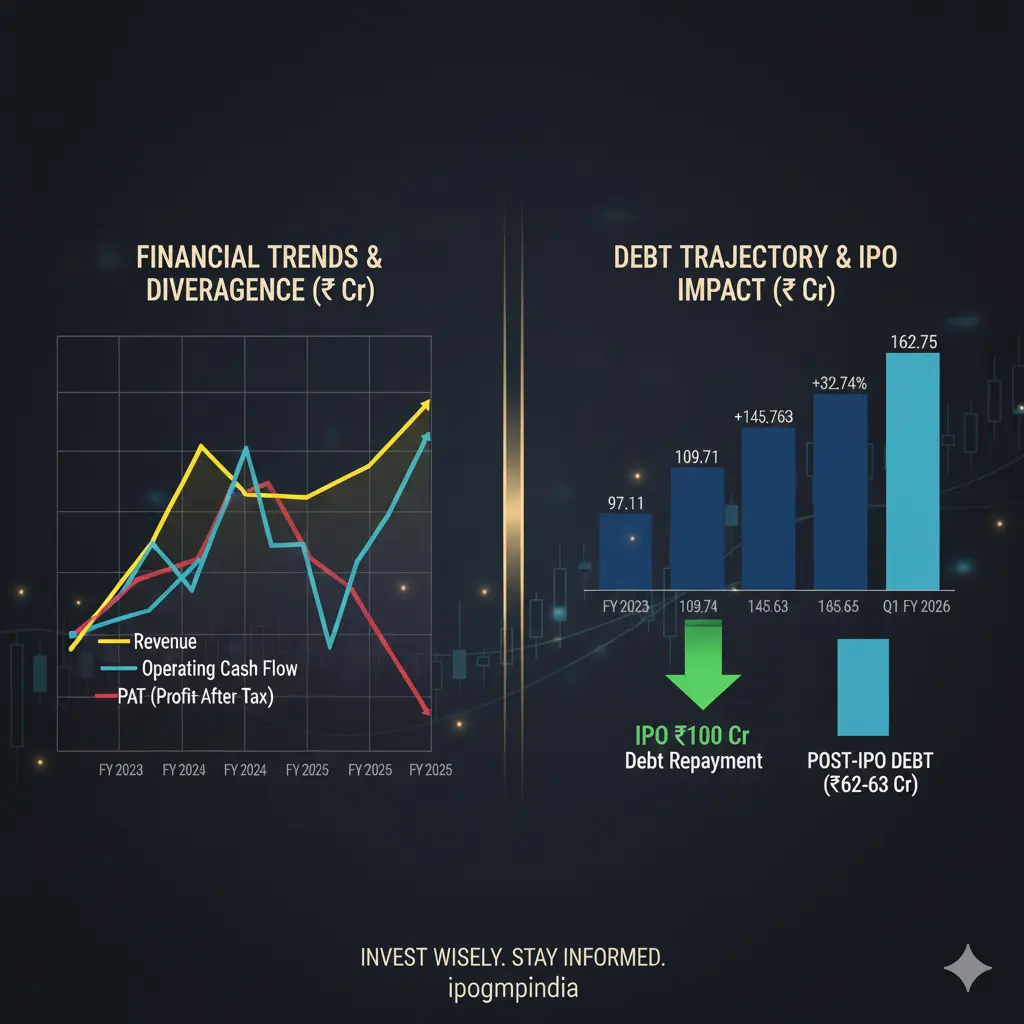
| Total Borrowing (₹ Cr) | 97.11 | 109.71 | 145.63 | 162.75 |
Growth Analysis: FY 2024-25 vs FY 2023-24
Revenue Growth: 25% YoY
- FY 2024: ₹1,188.49 crores
- FY 2025: ₹1,491.45 crores
- Absolute Growth: ₹302.96 crores
This 25% revenue growth significantly outpaces India’s nominal GDP growth, indicating market share gains and capacity utilization improvements. The company has successfully scaled operations while maintaining customer relationships.
Profit After Tax Growth: 59% YoY
- FY 2024: ₹25.68 crores
- FY 2025: ₹40.87 crores
- Absolute Growth: ₹15.19 crores
The 59% PAT growth, more than double the revenue growth rate, suggests improving operational efficiency and better margin management. However, this must be viewed alongside the operating cash flow concerns discussed later.
EBITDA Growth: 41% YoY
- FY 2024: ₹45.52 crores
- FY 2025: ₹64.22 crores
- Growth: ₹18.70 crores
EBITDA growth of 41% indicates strong operational leverage, where revenue growth translates into disproportionately higher operating profits.
Asset Base Expansion
The asset base has grown from ₹247.84 crores (FY24) to ₹331.33 crores (FY25), representing a 34% increase. This expansion reflects:
- Capacity addition investments
- Working capital requirements for higher sales
- Inventory buildup for the new product lines
⚠️ Critical Concern: Operating Cash Flow
| Period | Operating Cash Flow (₹ Cr) | PAT (₹ Cr) | OCF/PAT Ratio |
|---|---|---|---|
| FY 2023 | Positive (Healthy) | 21.53 | Good |
| FY 2024 | ₹2.00 (Drastically Reduced) | 25.68 | 0.08 |
| FY 2025 | ₹(16.84) Negative | 40.87 | -0.41 |
| Q1 FY 2026 | ₹(3.71) Negative | 12.06 | -0.31 |
This is the most concerning aspect of Vidya Wires’ financials. Despite reporting strong profit growth, the company’s ability to convert those profits into actual cash has deteriorated dramatically:
- FY 2023: Healthy positive operating cash flows
- FY 2024: Collapsed to just ₹2 crores despite ₹25.68 crore PAT
- FY 2025: Turned negative at ₹-16.84 crores with ₹40.87 crore PAT
- Q1 FY 2026: Continues negative at ₹-3.71 crores
Possible Reasons:
- Aggressive revenue recognition practices
- Increasing receivables (delayed customer payments)
- Inventory buildup ahead of capacity expansion
- Extended credit periods to win customers
- Working capital mismanagement
Red Flag Analysis: As noted by CA Pradeep Rajput, companies often have “just enough time” to present a rosy picture before IPOs. The timing of deteriorating cash flows with IPO launch raises questions about sustainability of reported profits.
Debt Trajectory
Key Ratios (March 31, 2025)
Financial ratios provide standardized metrics for comparing Vidya Wires with industry peers and assessing operational efficiency.
| Ratio | Value (FY 2025) | Interpretation | Industry Benchmark |
|---|---|---|---|
| Return on Equity (ROE) | 24.57% | Excellent | 15-20% |
| Return on Capital Employed (ROCE) | 19.72% | Good | 15-18% |
| Debt to Equity | 0.88 | Moderate | <1.0 |
| Return on Net Worth (RoNW) | 24.57% | Strong | 15-20% |
| PAT Margin | 2.74% | Low | 3-5% |
| EBITDA Margin | 4.32% | Low | 5-8% |
Detailed Ratio Analysis
Return on Equity (ROE): 24.57%
ROE of 24.57% is impressive, indicating that for every ₹100 of shareholder equity, the company generates ₹24.57 in profit. This exceeds the industry average of 15-20%, suggesting efficient capital utilization. However, this must be viewed cautiously given the negative operating cash flows—high ROE with poor cash conversion can indicate aggressive accounting.
Return on Capital Employed (ROCE): 19.72%
ROCE measures how efficiently the company uses both equity and debt capital. At 19.72%, it’s healthy and indicates that the business model generates adequate returns above the cost of capital (typically 10-12% for manufacturing firms).
Debt to Equity: 0.88
At 0.88, the company has ₹88 of debt for every ₹100 of equity. This is within acceptable limits (generally <1.0 is considered safe), but the post-IPO reduction to approximately 0.35-0.40 will significantly strengthen the balance sheet.
PAT Margin: 2.74%
This is the weak spot. A PAT margin of just 2.74% indicates the company operates in a low-margin, commodity-like business where pricing power is limited. For every ₹100 of sales, only ₹2.74 becomes net profit. The wire manufacturing industry is inherently low-margin due to:
- Commodity raw material (copper, aluminum) pricing
- Intense competition
- Limited differentiation
EBITDA Margin: 4.32%
At 4.32%, EBITDA margins are also compressed, though slightly better than PAT margins. The differential between EBITDA (4.32%) and PAT (2.74%) margins—1.58 percentage points—represents depreciation, interest, and tax burden.
Post-IPO Expected Improvements
With ₹100 crore debt repayment:
- Interest savings: Approximately ₹10-12 crores annually (assuming 10-12% cost of debt)
- Improved PAT margin: Could increase to 3.5-4.0%
- Debt-Equity ratio: Will improve to ~0.35-0.40
- Interest coverage: Will strengthen significantly
Valuation Metrics
Understanding valuation is crucial for determining whether Vidya Wires IPO is priced attractively or expensively relative to earnings and book value.
| Valuation Metric | Pre-IPO | Post-IPO | Commentary |
|---|---|---|---|
| EPS (₹) | 2.55 | 2.27 | Dilution impact |
| P/E Ratio (x) | 20.36 | 22.94 | Moderate premium |
| Price to Book Value | 6.62 | – | Premium to book |
| Market Cap (₹ Cr) | 1,106 | ~1,400 | Post-money valuation |
Earnings Per Share (EPS) Analysis
Pre-IPO EPS: ₹2.55
- Based on FY 2025 earnings (₹40.87 crores PAT)
- Pre-issue share capital (16 crore shares)
- Calculation: ₹40.87 Cr ÷ 16 Cr shares = ₹2.55
Post-IPO EPS: ₹2.27
- Based on annualized Q1 FY 2026 earnings (₹48.24 crores projected)
- Post-issue share capital (21.27 crore shares)
- Calculation: ₹48.24 Cr ÷ 21.27 Cr shares = ₹2.27
The EPS dilution of 11% (from ₹2.55 to ₹2.27) is reasonable and typical for IPOs. The post-IPO EPS uses annualized quarterly earnings, which may not fully capture seasonal variations or one-time items.
Price-to-Earnings (P/E) Ratio
Pre-IPO P/E: 20.36x At the upper price band of ₹52, investors are paying ₹20.36 for every ₹1 of FY 2025 earnings.
Post-IPO P/E: 22.94x On annualized current earnings, the P/E expands to 22.94x due to:
- Equity dilution reducing per-share earnings
- Using higher recent quarterly run rate
Peer Comparison
| Company | P/E Ratio | PAT Margin | EBITDA Margin | Revenue (₹ Cr) |
|---|---|---|---|---|
| Vidya Wires Limited | 22.94 | 2.74% | 4.32% | 1491 |
| Precision Wires India Limited | ~45-50 | 4-5% | 6-7% | 2,500+ |
| Ram Ratna Wires | ~40-45 | 3-4% | 5-6% | 1,800+ |
| Apar Industries | ~50-55 | 6-7% | 9-10% | 15,000+ |
Key Insights from Peer Comparison:
- Significantly Discounted Valuation: Vidya Wires is coming at approximately 50% discount to peer valuations on P/E basis. Peers trade at 40-55x P/E while Vidya Wires is priced at ~23x.
- Lower Margins: The discount is partially justified by lower PAT (2.74%) and EBITDA (4.32%) margins compared to peers.
- Smaller Scale: With ₹1,491 crore revenue, Vidya Wires is smaller than established players, which limits bargaining power with suppliers and customers.
- Valuation Opportunity: If the company can:
- Improve margins post-expansion (economies of scale)
- Successfully repay debt (interest savings)
- Maintain growth trajectory
Price to Book Value: 6.62x
At 6.62x book value, investors pay ₹6.62 for every ₹1 of net asset value. This premium reflects:
- Expected future growth and profitability
- Intangible assets like customer relationships
- Operating leverage from capacity expansion
For manufacturing companies, P/B ratios of 5-8x are common when ROE exceeds 20%
Use of Proceeds
Understanding how the company will deploy IPO proceeds is critical for assessing whether the funds will be used productively or unproductively.
| S.No. | Purpose | Amount (₹ Crores) | % of Total |
|---|---|---|---|
| 1 | Capex for new project in subsidiary (ALCU) | 140.00 | 51.1% |
| 2 | Debt repayment/prepayment | 100.00 | 36.5% |
| 3 | General corporate purposes | ~34.00 | 12.4% |
| Total Net Proceeds | ~274.00 | 100% |
Detailed Fund Utilization Analysis
1. Capex for Subsidiary ALCU: ₹140 Crores (51%)
The largest allocation will fund setting up a new manufacturing project in the subsidiary. This represents:
Productive Use: This is growth capex that will:
- Add 18,000 MTPA capacity (nearly doubling current 19,680 MTPA)
- Enable new product launches (copper foils, solar cables, aluminum winding wires)
- Generate incremental revenue of ₹800-1,000 crores (estimated at full utilization)
- Improve EBITDA by ₹35-40 crores annually (at 4-5% margins)
Timeline: The expansion project at Narsanda, Gujarat is likely to be completed within 18-24 months, with commercial production starting by FY 2027.
Revenue Impact: At 90% capacity utilization and current realization rates, the expanded capacity could add:
- Additional revenue: ₹850-900 crores
- Additional EBITDA: ₹36-40 crores
- Additional PAT: ₹22-25 crores
This would increase total revenue to ₹2,300-2,400 crores by FY 2028, representing 50%+ growth from current levels.
2. Debt Repayment: ₹100 Crores (36.5%)
The second-largest allocation will retire existing borrowings of ₹100 crores from the current ₹162.75 crores total debt.
Why This Matters:
| Parameter | Pre-IPO | Post-IPO | Improvement |
|---|---|---|---|
| Total Debt | ₹162.75 Cr | ₹62.75 Cr | -61% |
| Debt/Equity | 0.88 | ~0.35 | -60% |
| Annual Interest Cost | ~₹16-18 Cr | ~₹6-7 Cr | -₹10-11 Cr |
| Interest Coverage | 4.0x | ~10.0x | +150% |
Financial Benefits:
- Interest savings: ₹10-11 crores annually
- PAT improvement: ₹7-8 crores (after tax impact)
- Margin expansion: PAT margin could improve from 2.74% to 3.2-3.5%
- Balance sheet strength: Lower leverage provides cushion during downturns
Strategic Importance: Given the concerning trend of negative operating cash flows, debt reduction is prudent. It reduces financial risk and improves interest coverage, critical when Adani and Birla are entering the sector with deep pockets.
3. General Corporate Purposes: ₹34 Crores (12.4%)
The remaining proceeds will be used for:
- Working capital requirements (inventory, receivables)
- Brand building and marketing
- Technology upgrades
- Contingency buffer
While “general corporate purposes” is a catch-all category, the 12.4% allocation is reasonable and not excessive (some IPOs allocate 30-40% here, which is concerning).
Overall Assessment: Productive Use
Positive Aspects:
- 87.6% of proceeds allocated to specific, quantifiable uses
- Capacity expansion will drive future growth
- Debt reduction will improve profitability and financial stability
- No money being used for promoter exit (only ₹26 crore OFS)
Concerns:
- No allocation for improving working capital cycle (addressing negative OCF)
- No specific mention of receivables management or inventory optimization
- Given cash flow concerns, some proceeds should have been earmarked for working capital improvement
Final Conclusion
Vidya Wires IPO presents a classic high-risk, high-reward opportunity. The 50% valuation discount to peers cannot be ignored, but neither can the promoter governance issues, negative cash flows, and competitive threats from Adani-Birla.
For sophisticated investors who understand these risks, accept them, and can monitor actively: The IPO offers asymmetric potential—limited downside (given valuation) with possible 30-50% upside if execution improves and stock re-rates.
For most retail investors: The risks outweigh rewards. Better to wait, watch post-listing performance for 2-3 quarters, and invest only if cash flows improve and competitive positioning remains intact.
Remember: Investment decisions should be based on your financial goals, risk appetite, and due diligence—not on any single expert opinion or review.
Disclaimer: This article is for educational and informational purposes only. It does not constitute financial advice or investment recommendation. Investors should conduct their own research and consult with certified financial advisors before making investment decisions. IPO investments carry market risks. Past performance does not guarantee future results.