Last Updated: Feb 2026 | Reading Time: 10 mins | Market: USA + India
Quick Answer: Yes — American Express is a genuinely good credit card, but only for the right person. In the USA, Amex excels at premium rewards, travel benefits, and customer service. In India, Amex is a strong mid-to-premium card option — but acceptance gaps and the RBI restriction history (now resolved) mean it suits urban, high-spending professionals more than general-use cardholders.
Is Amex a Good Credit Card? — The Honest Verdict
American Express has one of the strongest reputations in the credit card industry — but “good” depends entirely on how you use it and where you live.
Here is the honest, unfiltered answer:
In the USA: Amex is among the top 2–3 credit card issuers for premium cardholders. The Amex Platinum and Gold cards consistently rank among the highest-rated travel and rewards cards in the market. The customer service is genuinely excellent — J.D. Power has ranked Amex first or second in customer satisfaction among major card issuers for over a decade. The rewards ecosystem (Membership Rewards points) is one of the most flexible and valuable in the industry.
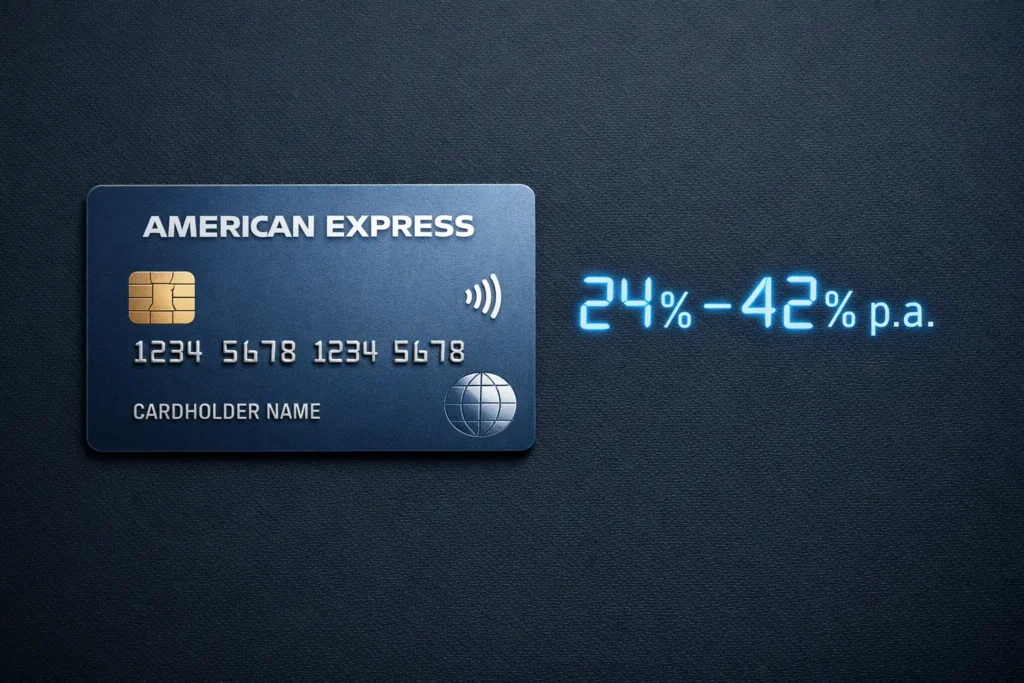
In India: Amex is a solid premium card choice for urban professionals who spend heavily on dining, travel, and online purchases. The Membership Rewards programme is strong, customer service is responsive, and the card carries a premium status perception. However, acceptance at smaller merchants remains a real limitation, and interest rates at 36%–42% p.a. are among the higher end of the Indian credit card market.
Bottom line: Amex is a good-to-excellent card for premium and frequent spenders. It is not the best choice for someone who wants a single all-purpose card accepted everywhere, or for someone who carries a monthly balance.
Why Was Amex Banned in India? RBI Restriction History Explained
This is the most-searched question about Amex in India — and it deserves a clear, accurate answer.
What happened: In May 2021, the Reserve Bank of India (RBI) barred American Express Banking Corporation from onboarding new domestic customers in India. The restriction was imposed under the Payment and Settlement Systems Act, 2007, specifically for non-compliance with RBI’s data localisation norms.
What the data localisation rules required: The RBI had mandated that all payment system operators store Indian payment data exclusively on servers located within India. The deadline for compliance was October 2018. American Express — along with Mastercard and Diners Club — failed to meet this requirement to the RBI’s satisfaction by the compliance assessment date.
What the ban actually meant:
- Amex could NOT issue new cards to new Indian customers from May 2021
- Existing Amex India cardholders were completely unaffected — their cards continued to work normally
- All Amex India card benefits, rewards, and services continued for existing customers without interruption
- Amex continued all merchant acquiring and processing operations in India
When the ban was lifted: The RBI lifted the restriction on American Express in August 2021 — approximately three months after it was imposed — after Amex demonstrated compliance with the data localisation requirements to the RBI’s satisfaction.
Current status: American Express is fully operational in India as of 2026. New customer onboarding is completely open. All card products are available. The RBI restriction is historical in 2025 — it lasted approximately 3 months and had zero impact on existing cardholders.
Why this matters for your decision: The RBI ban is frequently cited in online forums as a reason to avoid Amex India. This is outdated and inaccurate. The restriction was resolved in 2021, Amex is fully compliant, and there is no ongoing regulatory concern for Indian cardholders.
Is American Express Good in India?
Yes — with specific strengths and one genuine limitation.
What makes Amex genuinely good in India:
1. Membership Rewards Programme Amex India’s Membership Rewards points are among the most flexible in the Indian market. Points can be redeemed against statement balances, transferred to frequent flyer programmes (IndiGo, Air India, Singapore Airlines, and others), converted to gold coins via the 18-karat gold collection, or used with partner brands. The earning rate on the Platinum Travel card (1 point per ₹50) with bonus categories is competitive for premium spenders.
2. Customer Service Amex India’s customer service is consistently rated as superior to most Indian bank card issuers. 24/7 phone support, responsive online chat, and proactive fraud detection are genuine strengths that cardholders notice.
3. Welcome and Milestone Benefits Amex India cards offer strong welcome bonuses and annual milestone benefits — travel credits, reward multipliers, and bonus points — that can justify the annual fee for moderate-to-high spenders.
4. EMI Flexibility Amex India offers EMI conversion on eligible transactions with competitive rates compared to revolving credit. For large planned purchases, this is a meaningful financial tool.
The genuine limitation — Merchant Acceptance: This is real and should not be dismissed. Amex India acceptance, while improved significantly, still has gaps at smaller merchants, local stores, petrol stations, and budget restaurants. In tier-2 and tier-3 Indian cities, acceptance is noticeably lower than Visa or Mastercard. For cardholders who want one card that works everywhere in India, Amex is not that card — a Visa or Mastercard should be the backup.
Amex USA — Pros and Cons
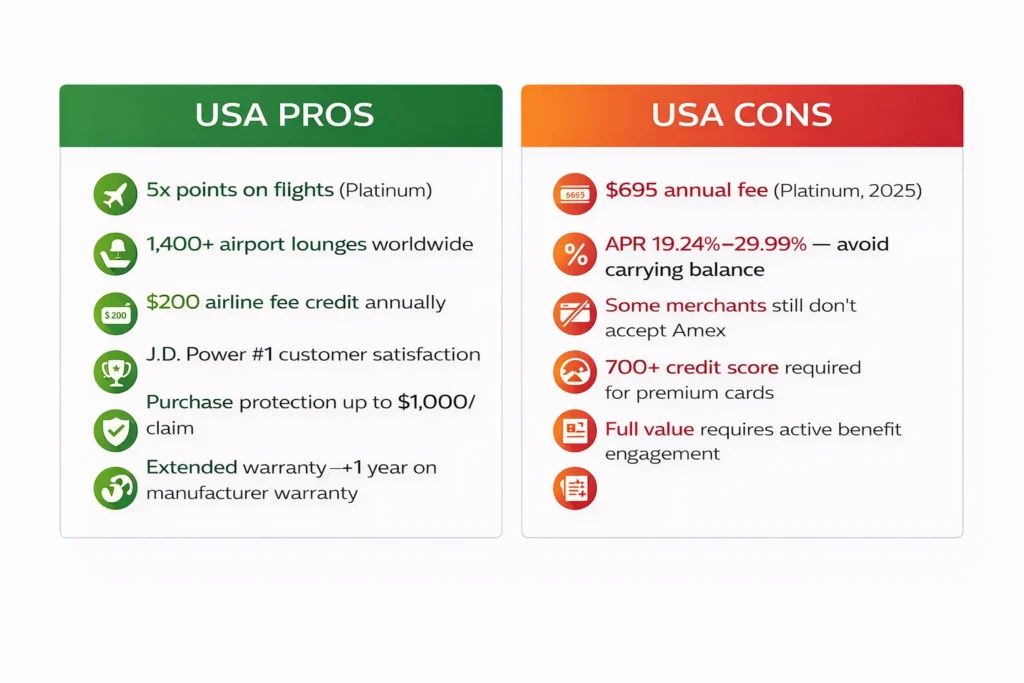
✅ USA Pros
- World-class rewards programme: Amex Membership Rewards points are widely regarded as one of the most valuable flexible currencies in the US credit card market. Transfer partners include Delta, British Airways, Air France/KLM, Hilton, Marriott, and many more. The Amex Platinum alone offers 5x points on flights booked directly with airlines — among the highest earn rates available.
- Premium travel benefits: The Amex Platinum provides access to 1,400+ airport lounges worldwide (Centurion Lounges, Priority Pass, Delta Sky Clubs with Delta tickets, and others), up to $200 annual airline fee credit, $200 Uber Cash annually, TSA PreCheck/Global Entry fee credit, and hotel elite status with Marriott and Hilton — all on a single card.
- Outstanding customer service: J.D. Power has consistently ranked American Express first or near-first in US credit card customer satisfaction. Dispute resolution, fraud protection, and concierge services are all significantly above industry average.
- Purchase protection and extended warranty: Amex USA cards offer industry-leading purchase protection (up to $1,000 per claim for damage or theft of new purchases) and extended warranty (adds up to 1 extra year on manufacturer warranties). For electronics and appliances, this is genuinely valuable.
- No preset spending limit (select cards): Premium Amex charge cards have no preset spending limit — the limit adjusts based on your spending patterns, payment history, and creditworthiness. For high-spending months, this flexibility is a real advantage.
❌ USA Cons
- High annual fees: The Amex Platinum carries a $695 annual fee (as of 2025) — among the highest of any consumer credit card. While the credits and benefits can justify this for heavy users, it requires active engagement to extract full value. Cardholders who don’t use the travel credits, Uber Cash, and lounge access will overpay significantly.
- Acceptance gaps still exist: Despite Amex’s 99% US acceptance rate, some merchants — particularly small businesses, certain food markets, and budget retailers — still do not accept Amex due to higher merchant processing fees. Costco is a well-known example that shifted away from Amex.
- Interest rates are not competitive: If you carry a balance, Amex is not your friend. APRs of 19.24%–29.99% are in line with or above industry average. Amex cards are optimised for people who pay in full every month.
- Credit score requirements are high: Most premium Amex cards require good-to-excellent credit (700+ FICO score). Entry-level products are more accessible, but the headline Platinum and Gold cards are not designed for credit-building.
Amex India — Pros and Cons
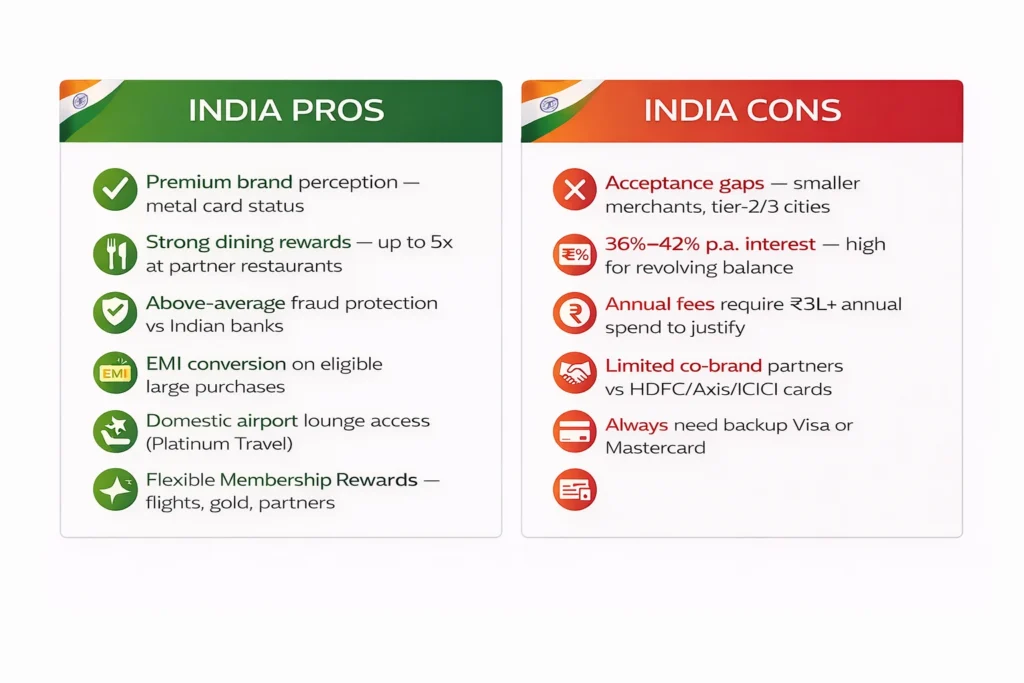
✅ India Pros
- Premium brand perception: Carrying an Amex card in India still carries a premium status perception — particularly the metal Platinum card. For professionals and business owners, this is a tangible soft benefit.
- Strong dining and travel rewards: Amex India cards offer strong rewards on dining (up to 5x points at partner restaurants) and travel, matching or exceeding comparable Visa/Mastercard premium products from Indian banks in these categories.
- Reliable fraud protection: Amex India’s fraud detection and resolution process is consistently rated above Indian bank card issuers. Disputed transactions are typically resolved faster, and proactive SMS/email alerts are effective.
- EMI options: Amex India provides EMI conversion on eligible transactions — useful for large purchases at competitive rates versus revolving credit. No-Cost EMI is available at select partner merchants.
- Airport lounge access (select cards): The Amex Platinum Travel Card provides complimentary domestic airport lounge access in India — useful for frequent travellers on Indian carriers.
❌ India Cons
- Merchant acceptance gaps: This is Amex India’s most significant weakness. While acceptance has improved in metros, Amex is still not accepted at a meaningful percentage of tier-2/tier-3 city merchants, local grocery stores, petrol stations, and budget restaurants. A Visa or Mastercard is essential as backup.
- High interest rates: At 36%–42% p.a. (3%–3.5% per month), Amex India interest rates are at the higher end of the Indian credit card market. HDFC, ICICI, and SBI cards often offer similar rates, but some premium cards from these banks have lower rates. If you carry a revolving balance, Amex is expensive.
- Annual fees not always justified for moderate spenders: Amex India annual fees range from ₹1,500 to ₹60,000 depending on the card. For moderate spenders (under ₹3–5 lakhs annually), the annual fee may not be justified by rewards earned. The premium cards deliver best value for high spenders.
- Limited co-brand partnerships in India: Compared to Visa/Mastercard co-branded cards from HDFC, Axis, or ICICI (which partner with Swiggy, Amazon, Flipkart, Myntra, etc.), Amex India’s co-brand ecosystem is narrower. You get fewer targeted cashback opportunities on everyday Indian e-commerce.
USA vs India — Side-by-Side Comparison
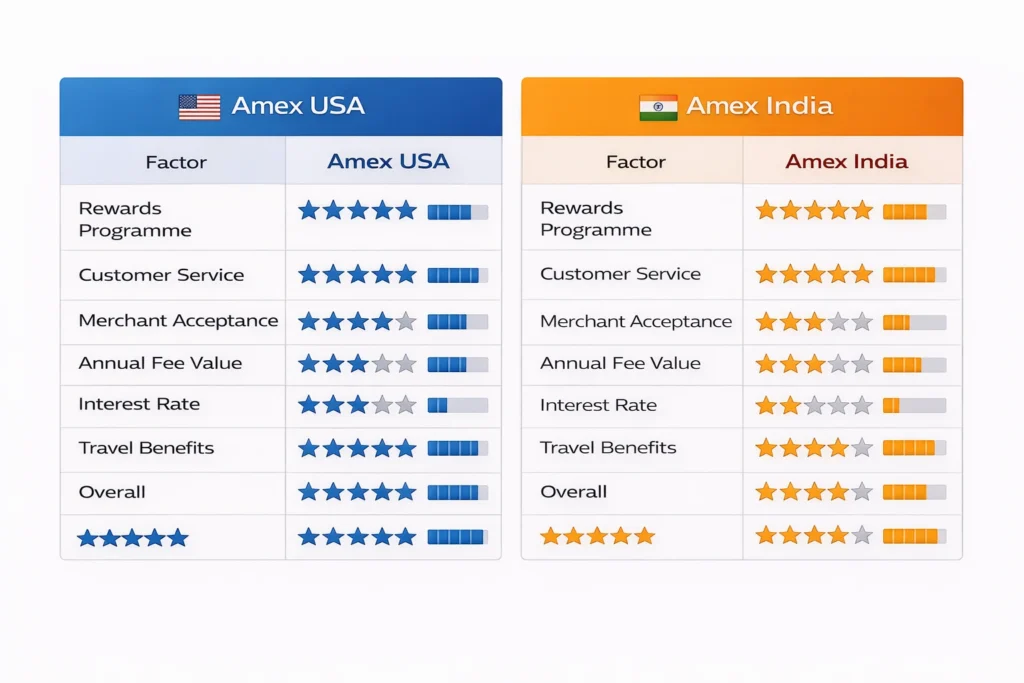
| Factor | Amex USA | Amex India |
|---|---|---|
| Rewards Programme | Excellent — top tier in market | Good — strong in dining & travel |
| Customer Service | Excellent — J.D. Power #1 rated | Very Good — above Indian bank average |
| Merchant Acceptance | Very Good — 99% US merchants | Moderate — gaps at smaller merchants |
| Annual Fee Value | Good for heavy users, poor for light | Good for high spenders (5L+/year) |
| Interest Rate | 15.99%–29.99% APR — market standard | 36%–42% p.a. — above market average |
| Travel Benefits | Excellent (Platinum) — lounge, credits | Good — domestic lounge access |
| Overall Rating | ⭐⭐⭐⭐⭐ (premium segment) | ⭐⭐⭐⭐ (for right profile) |
Who Should Get an Amex Card?
You are the ideal Amex cardholder in the USA if:
- You spend $3,000–$5,000+ per month on eligible categories
- You travel frequently and value airport lounge access and travel credits
- You always pay your full statement balance — you never carry a revolving balance
- You value strong customer service and purchase protection over raw cashback rates
- Your credit score is 700+ and you qualify for premium products
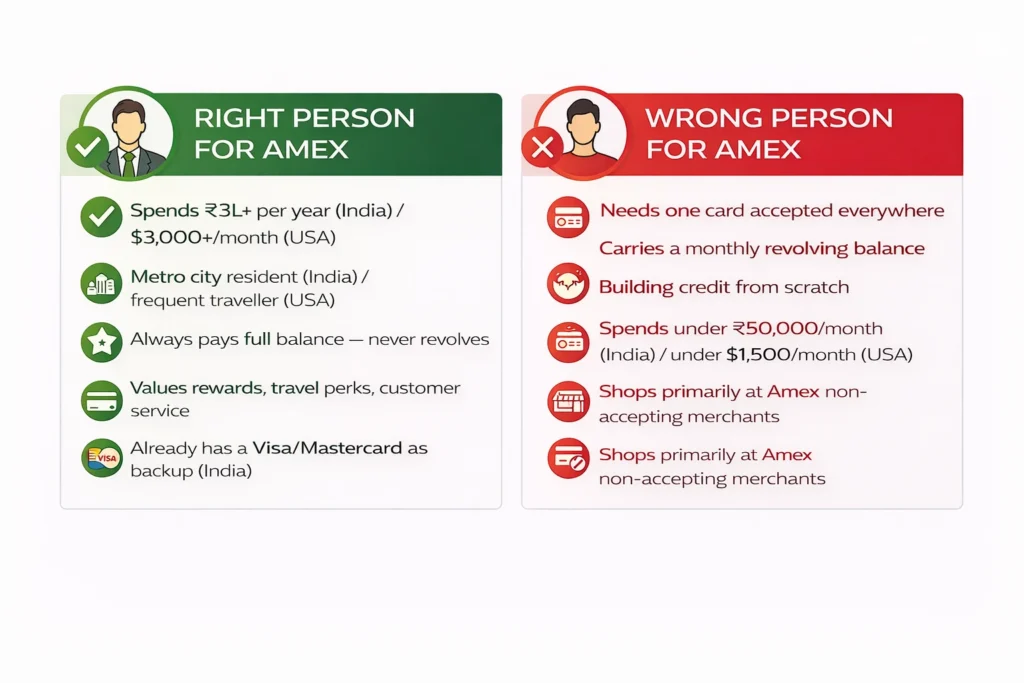
You are the ideal Amex cardholder in India if:
- You are based in a metro city (Mumbai, Delhi, Bengaluru, Hyderabad, Chennai, Pune)
- You spend ₹3–5 lakhs or more annually on the card
- You frequently dine at restaurants and travel domestically or internationally
- You always pay your full statement balance each month
- You already have a Visa or Mastercard as your primary/backup card
Who Should NOT Get an Amex Card?
Amex is NOT the right choice if:
- You need one card accepted everywhere — especially in rural India or outside major international cities
- You carry a monthly balance — the interest rates make revolving debt very expensive on Amex
- You are building credit from scratch — better entry-level options exist
- Your monthly spend is modest (under ₹50,000 in India / under $1,500 in USA) — the annual fee value proposition weakens significantly at lower spend levels
- You primarily shop at merchants that don’t accept Amex (Costco in USA; local kirana stores, petrol pumps in smaller Indian cities)
Is Amex a good credit card company?
Is Amex the best credit card in the USA?
Is Amex good in India in 2026?
Why is Amex banned in India?
Why is Amex banned in India?
Why is Amex better than Visa or Mastercard?
Is Amex credit card free in India?
Is Amex issuing cards in India currently?
🧮 Planning a large Amex purchase? Use the Amex EMI Calculator → to calculate your exact monthly installment before you swipe — free, instant, no login.
📌 Related Reading: All American Express Credit Cards — Which Is Best for You? | Amex Interest Rate Guide — USA & India | Is American Express Interest Free? Grace Period Explained
Disclaimer: Card benefits, fees, and terms are subject to change. Always verify current offers directly on AmericanExpress.com or AmericanExpress.com/in. This article is for informational purposes only and does not constitute financial advice.

Mayank Srivastava is a Indian Stock Market Expert with over 2+ years of experience in financial markets and investment analysis. He specializes in IPO evaluations, grey market premium tracking,various stock market strategies, derivatives strategies and data-driven investment research.
His analysis has helped thousands of retail investors make informed decisions in the Indian primary market. Mayank holds advanced certifications in financial Market and regularly contributes to leading financial publications. But he is not SEBI registered Finance Professional. He writes only for educational purpose not giving any investment advice. Please Consult SEBI Registered Finance Consultant or Professional before any investment in stock market. He is not responsible any investment loss after reading this website content