
Last updated: 19 August 2026
⚠️ Grey Market Premium (GMP) is an unofficial, unregulated indicator. It is not recognised or endorsed by SEBI, NSE, or BSE. GMP figures are informal, sourced from grey-market participants, and can change hourly — treat them as one input, not a guarantee of listing performance.
What Is GMP (Grey Market Premium) in an IPO?
Grey Market Premium (GMP) is the unofficial premium at which IPO shares trade before their official stock exchange listing. It reflects investor demand in the informal grey market and is often used to estimate potential listing gains — though it is unregulated, unofficial, and not always an accurate predictor of actual listing price.
Where does the “grey market” actually operate?
The grey market isn’t a physical location or a platform you can log into — it’s an informal, over-the-counter network of dealers and brokers who quote prices for IPO applications and shares before they’re officially tradable on NSE or BSE. Deals are typically struck over phone or messaging apps, settled in cash, and rest entirely on trust between the two parties. There’s no exchange, no clearing corporation, and no order book behind any of it.
This matters because of a structural gap in the IPO process: once an issue closes for subscription, there’s usually a window of a few trading days before allotment is finalised and shares actually list. Grey market activity fills that waiting period, letting people who are confident (or anxious) about an allotment lock in a price early.
Who trades in it, and why it’s unofficial
Participants are mostly a mix of retail applicants looking to book profit before listing, and grey-market dealers who make a market in IPO paper the way a bookmaker prices an event. Because none of this happens through SEBI-registered intermediaries or exchange infrastructure, there’s no regulatory oversight, no investor protection mechanism, and no legal recourse if a counterparty walks away from a deal. It is, in effect, “curb trading” — a term used informally within the industry, including by regulators — happening in parallel to, but outside, the formal market.
SEBI has been actively looking to close this gap: officials have discussed introducing a regulated “when-listed” trading platform that would let investors trade shares in a proper, supervised environment during the three-day gap between allotment and listing, precisely to reduce reliance on the unofficial grey market. As of this update, that platform hasn’t fully replaced grey market activity, so GMP remains the dominant sentiment signal retail investors track.
How Is IPO GMP Calculated?
The basic formula
GMP itself isn’t calculated by any formula — it’s simply the price grey-market dealers quote based on live supply and demand for a given IPO’s shares or applications. But once you have that quoted number, the maths that follows it is simple:
Estimated Listing Price = Issue Price + GMP
For example, if an IPO is priced at ₹500 per share and the grey market is quoting a GMP of ₹80, the informal expectation is that the stock could open around ₹580 — an implied listing gain of roughly 16%.
Why GMP for the same IPO differs across websites
If you check three different GMP tracker sites for the same IPO, don’t be surprised to see three different numbers. GMP isn’t published from a single centralised source — each platform pulls its figure from its own network of grey-market contacts, and those dealers themselves may be quoting slightly different prices at any given moment based on their own order flow. There’s no obligation for any of these numbers to reconcile, which is itself a useful reminder of how informal the entire system is.
How often GMP is updated during the subscription window
GMP is at its most volatile in the final hours of an IPO’s subscription window, once overall and category-wise subscription numbers start coming in. Many tracker sites refresh their quotes every 15–30 minutes during active trading hours on subscription days, and GMP can swing meaningfully — up or down — as fresh subscription data, anchor investor commentary, or broader market moves come in. It typically stabilises somewhat between the close of subscription and the listing date, but can still shift right up to listing day based on overall market sentiment.
GMP vs Kostak Rate vs Subject-to-Sauda — What’s the Difference?
These three terms get used almost interchangeably by beginners, but they represent three distinct kinds of grey-market deals.
| Term | What It Means | Who Uses It | Risk Level |
|---|---|---|---|
| GMP | Premium over issue price for the share itself | Investors gauging listing-day sentiment | Informational only — no money changes hands on the basis of GMP alone |
| Kostak Rate | A flat price paid to buy your entire IPO application, regardless of whether it gets allotted | Applicants who want a guaranteed, fixed profit without waiting to see if they’re allotted shares | Lower for the seller (payment isn’t contingent on allotment), but still an unofficial, unenforceable deal |
| Subject to Sauda (SS) | Similar to Kostak, but the deal only goes through if the application actually receives an allotment | Applicants and dealers who want a higher payout in exchange for taking on allotment risk together | Conditional — higher potential payout, but the deal collapses to zero if there’s no allotment |
A quick way to remember the difference: Kostak is “I’ll pay you now, allotment or not.” Subject to Sauda is “I’ll pay you more, but only if you actually get shares.” GMP, by contrast, isn’t a transaction at all — it’s a quoted expectation of where the share itself will trade once it lists.
For example, on an IPO priced at ₹500 with a lot size of 30 shares: a GMP of ₹50 implies an expected listing price of ₹550; a Kostak rate of ₹800 means a dealer will pay ₹800 for your application itself, win or lose the allotment lottery; a Subject to Sauda quote of ₹1,200 means you get that amount only if your application is actually allotted shares.
How Accurate Is GMP in Predicting Listing Gains?
GMP is best understood as a sentiment gauge, not a forecast. It tends to track the direction of listing-day movement reasonably well — a strongly positive GMP going into listing usually does correspond to some listing-day gain — but the magnitude it predicts is frequently off, sometimes by a wide margin.
Where GMP tends to line up with listing price
GMP has historically been a more reliable directional signal for IPOs that are heavily oversubscribed, where retail and HNI demand is unambiguous well before listing. In these cases, even if the exact percentage gain GMP implies doesn’t hold up precisely, the fact that the stock lists in positive territory is rarely a surprise.
Where GMP has been wrong
GMP has also been wrong often enough that relying on it exclusively has burned investors — both by overstating gains on IPOs that listed flat or down, and, less commonly, by understating gains on issues where last-minute institutional demand pushed the listing price well above what the grey market had priced in. Big, sudden shifts in the broader market — a sharp index correction, a global risk-off event, sector-specific bad news — in the days between an IPO’s subscription close and its listing can move the actual listing price meaningfully away from where GMP had settled, simply because GMP reflects sentiment at the time it was last quoted, not sentiment on listing morning.
(Editorial note for the site owner: this section is strongest with 3–5 specific, dated, and independently verifiable listing-day examples — pulled from your own tracked GMP history against actual NSE/BSE listing data — rather than generic claims. Publishing unverified specific company names and numbers here would undermine the page’s credibility, so plug in real, sourced cases from your own data before this goes live.)
SME IPOs vs mainboard IPOs
SME IPO grey markets tend to be thinner — fewer dealers, lower application volumes, and prices that can be swung by a handful of large orders. That can cut both ways: SME GMP sometimes overshoots dramatically on hype (leading to sharp corrections on listing), while mainboard IPO grey markets, with deeper participation, tend to average out individual dealers’ quirks and often (though not always) settle into a more stable, if not necessarily more accurate, number. Verify this pattern against your own current tracked data before publishing — the relative reliability of SME vs mainboard GMP shifts with market cycles and shouldn’t be stated as a permanent rule.
Live IPO GMP Tracker (Today’s Updates)
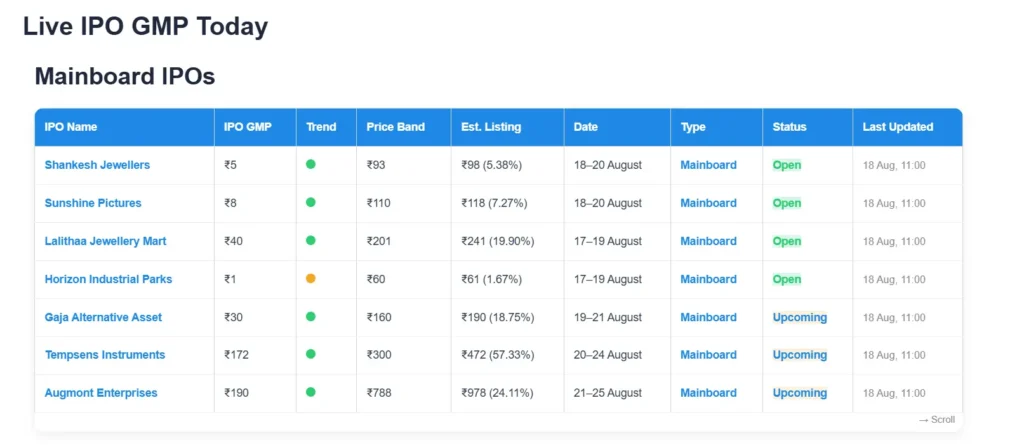
How to read this table
- Price Band: The official range set by the company for this IPO; allotment happens at a single price within (or occasionally at) this band.
- GMP (₹): The latest quoted grey-market premium per share, sourced informally and updated periodically.
- Est. Listing Gain (%): GMP expressed as a percentage of the issue price — i.e., what the grey market is implying the stock could gain on listing day. Treat this as an informal estimate, not a forecast.
- Subscription Status: How many times the issue has been subscribed, broken down by retail, NII (HNI), and QIB categories where available. Strong QIB subscription is generally considered a stronger fundamental signal than GMP alone.
- Last Updated: Timestamp of the most recent grey-market quote reflected in this row.
Related pages
Track individual companies in more depth on their dedicated pages — for example, “[Company Name] IPO GMP Today” — each of which links back to this guide for readers who want the full explanation of what GMP means and how to interpret it.
Should You Base Your IPO Investment Decision on GMP Alone?
Short answer: no. GMP is a useful, easy-to-read sentiment gauge, but it’s a single data point in a decision that deserves several.
What GMP does NOT account for
- Subscription levels by category. A high GMP paired with weak QIB (institutional) subscription is a different signal than a high GMP backed by strong institutional demand — GMP alone won’t tell you which situation you’re in.
- Anchor investor quality. Who committed money before the IPO opened — and at what price — often says more about the company’s medium-term prospects than the grey-market quote does.
- Market sentiment on listing day itself. GMP is a snapshot from before listing; broader index moves, sector news, or macro shocks between subscription close and listing day can move the actual price independent of anything GMP predicted.
- Company fundamentals. Valuation, revenue growth, debt levels, promoter background, and use of IPO proceeds — none of this shows up in a GMP number, but all of it matters for whether the stock is worth holding beyond day one.
A balanced checklist before you apply
- Check GMP as a rough sentiment gauge — not a target price.
- Look at subscription numbers by category, especially QIB.
- Read (or at least skim) the RHP for financials, valuation, and use of proceeds.
- Note anchor investor names and the price they came in at.
- Check what’s happening in the broader market in the days leading up to listing.
- Decide your holding horizon (listing-day flip vs longer-term hold) before applying — this changes how much weight GMP should carry in your decision.
Frequently Asked Questions
1. What does GMP mean in IPO?
2. Is GMP a guarantee of listing price?
3. Why does GMP differ between websites?
4. What is a good GMP percentage for an IPO?
5. Can GMP be negative?
6. Is trading in the grey market legal in India?
7. What is the difference between GMP and Kostak rate?
8. How often is GMP updated?
9. Does high GMP always mean the IPO will list in profit?
10. Where can I check today’s IPO GMP?
Disclaimer
Grey Market Premium (GMP) reflects informal, unregulated trading activity and is not recognised by SEBI, NSE, or BSE. Figures on this page are sourced from grey market channels and updated periodically; they may vary from actual listing prices. This content is for informational purposes only and should not be considered investment advice. Please consult a SEBI-registered financial advisor before making investment decisions.

Mayank Srivastava is a Indian Stock Market Expert with over 2+ years of experience in financial markets and investment analysis. He specializes in IPO evaluations, grey market premium tracking,various stock market strategies, derivatives strategies and data-driven investment research.
His analysis has helped thousands of retail investors make informed decisions in the Indian primary market. Mayank holds advanced certifications in financial Market and regularly contributes to leading financial publications. But he is not SEBI registered Finance Professional. He writes only for educational purpose not giving any investment advice. Please Consult SEBI Registered Finance Consultant or Professional before any investment in stock market. He is not responsible any investment loss after reading this website content