If you’ve been hunting for a broker that won’t eat your profits before the market even gets a chance to — you’ve landed in the right place.
Dhan has been making a lot of noise in the Indian stock trading world since its launch in 2021. And honestly, for good reason. Whether you’re a long-term investor or an active F&O trader, understanding the Dhan brokerage charges latest 2026 structure can save you thousands of rupees every month.
Let’s break it all down — segment by segment, charge by charge. No jargon. No drama. Just facts.
Let’s Use Our Dhan Brokerage Calculator
What is Dhan Broker? A Quick Background
Dhan (formerly Moneylicious Securities, now operating under Raise Securities Private Limited) is a SEBI-registered discount broker offering trading across NSE, BSE, and MCX. It was founded by Pravin Jadhav, former CEO of Paytm Money, and is backed by investors like Mirae Asset, Blume Ventures, and 3one4 Capital.
Dhan is registered with SEBI (Registration No: INZ000006031) and uses CDSL as its depository partner. The platform supports equities, ETFs, F&O, IPOs, mutual funds, and commodities.
Dhan Brokerage Account Opening Charges 2026
Let’s start with the first question most new investors ask — what does it cost to open an account?
Zero. Absolutely nothing.
Dhan does not charge any account opening fees or Annual Maintenance Charges (AMC) for its trading and demat account. No hidden fees on signup. No annual renewal surprises in your inbox.
This is a major advantage, especially if you’re comparing it to brokers like Zerodha, which charges ₹300 annually for demat account maintenance.
Dhan Brokerage Charges – Segment-Wise Breakdown
1. Dhan Brokerage Charges for Equity Delivery 2026
This is where Dhan really shines for long-term investors.
Dhan brokerage charges for equity delivery in 2026 are ₹0 — completely free.
Yes, you read that right. If you’re buying and holding stocks (delivery trades), Dhan charges you zero brokerage. ETFs and IPOs fall under the same free category.
So if you’re building a long-term portfolio in blue-chip stocks, Dhan costs you nothing on the brokerage front. The only charges you’ll pay are statutory ones — STT (0.1% on buy + sell), GST, SEBI charges, and stamp duty. These are government-regulated and apply across all brokers equally.
2. Dhan Intraday Charges 2026
Intraday trading means buying and selling within the same trading day. For this, Dhan charges:
₹20 per executed order or 0.03% of trade value — whichever is lower.
Let’s understand this with an example. Suppose you buy 50 shares of HDFC Bank at ₹1,520 each. Your total trade value = ₹76,000. The 0.03% comes to ₹22.80. Since ₹20 is lower, you pay ₹20. Simple, transparent, predictable.
This flat-fee model is a massive relief for high-value traders who’d otherwise pay a percentage-based brokerage running into hundreds of rupees per trade.
3. Dhan F&O Brokerage Charges 2026
F&O trading is where a lot of active traders live (and sometimes cry). Let’s look at Dhan’s F&O pricing.
Dhan F&O brokerage charges in 2026:
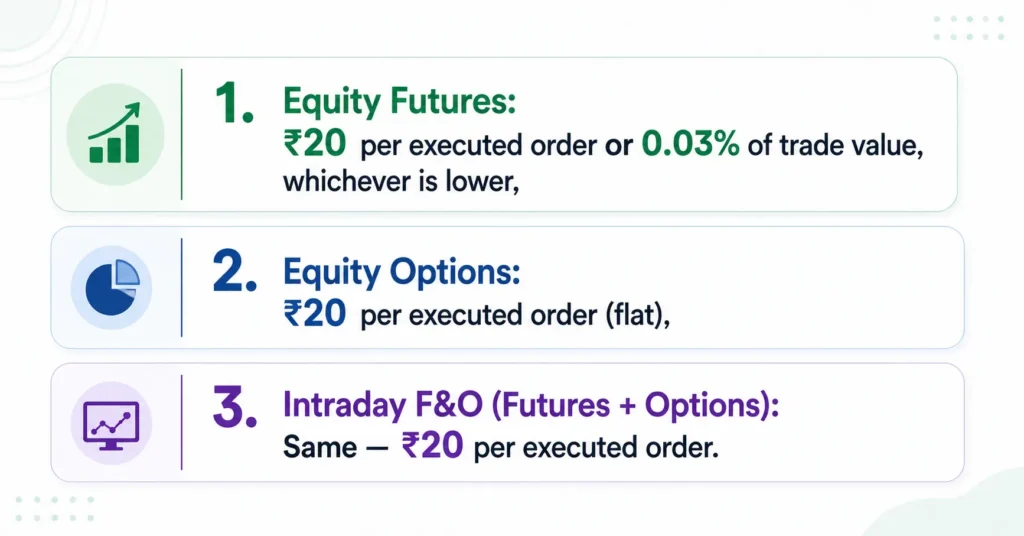
So whether you’re doing Nifty options or stock futures — intraday or carry forward — the brokerage stays flat at ₹20. No nasty surprises on contract expiry days.
Dhan intraday F&O brokerage charges in 2026 follow the same ₹20 flat structure, which is great because options traders often execute multiple legs in a day.
4. Dhan Brokerage Charges for Options 2026
Options trading deserves a separate mention because it’s the fastest-growing segment in India right now (SEBI data shows over 90% of F&O volumes come from options).
Dhan brokerage charges for options in 2026 = ₹20 per executed order — flat, regardless of lot size or premium value.
This means if you’re buying 1 lot of Bank Nifty options at ₹200 premium or 10 lots at ₹50 — brokerage is the same ₹20. That’s a great deal for big-quantity options traders.
Note: STT on options is 0.125% on the sell-side of premium (on exercised options it’s 0.125% on intrinsic value). This is a statutory charge, not Dhan’s fee.
5. Dhan Commodity Brokerage 2026
For commodity trading on MCX, Dhan follows the same flat-fee model:
₹20 per executed order or 0.03% of trade value — whichever is lower.
This covers commodity futures like gold, silver, crude oil, and agri-commodities. Note that Dhan currently does not support currency derivatives trading.
Complete Dhan Brokerage Charges Summary Table 2026
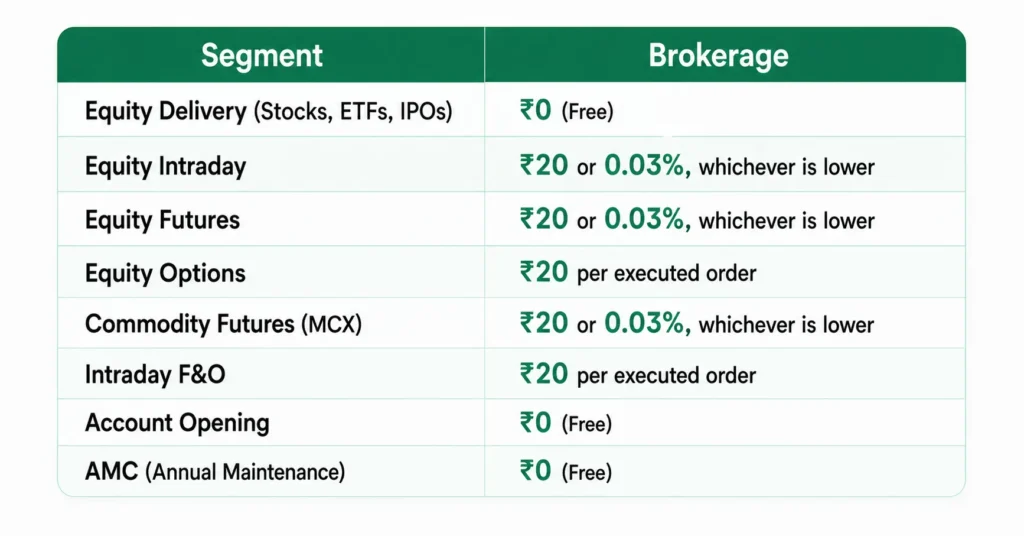
Source: Dhan Official Pricing Page
Special Offer: 50% Discount for Women Traders
Dhan offers a 50% discount on brokerage to all female customers. That means women pay just ₹10 per trade for intraday and F&O orders. This is a thoughtful step toward promoting gender parity in financial participation — and honestly, a pretty compelling reason to switch if you qualify.
Zerodha vs Dhan Brokerage Charges 2026
One of the most searched comparisons right now. Let’s keep it honest.
Both Zerodha and Dhan charge ₹0 for equity delivery and ₹20 per order for F&O. On paper, the brokerage structure is nearly identical.
The real differences lie elsewhere:
- Zerodha charges ₹300/year AMC for the demat account. Dhan charges nothing.
- Zerodha supports currency and commodity trading more comprehensively. Dhan lacks currency derivatives.
- Zerodha has Kite — an advanced, feature-heavy trading terminal. Dhan has a more modern, cleaner interface with native TradingView integration.
- Zerodha has Varsity — one of India’s best free stock market learning resources. Dhan doesn’t have an equivalent.
- Dhan’s platform is faster and more intuitive for options traders, with tools like Options Chain with Greeks, IV, and Max Pain analysis built-in.
Verdict: For pure cost comparison, they’re neck and neck. For options traders and beginners, Dhan’s zero AMC and modern UI give it a slight edge. For algo traders and commodity/currency traders, Zerodha wins.
Is Dhan Cheaper Than Groww?
Short answer: Yes, for most segments.
Groww charges ₹20 or 0.1% for equity delivery and intraday — meaning delivery trades are NOT free on Groww. Dhan gives you ₹0 delivery brokerage.
For futures and options, both charge ₹20 per order.
If you invest in stocks regularly and hold them, Dhan is significantly cheaper than Groww simply because Groww charges brokerage on delivery trades while Dhan does not.
Disadvantages of Dhan – Let’s Be Honest
No broker is perfect. Here are some genuine limitations of Dhan that you should know:
- No currency derivatives: Dhan does not currently support currency futures or options trading. If that’s your segment, look at Zerodha or Upstox.
- Smaller client base: With around 9.8 lakh active clients, Dhan is still growing compared to Zerodha’s 7.9 million. Smaller community can mean fewer third-party integrations and community support forums.
- No phone-based trading support (Call & Trade): Dhan doesn’t charge for call & trade, but the facility itself is limited. Zerodha charges ₹50 but offers it reliably.
- Research tools are basic: Dhan doesn’t have a strong research advisory ecosystem like Motilal Oswal or even Zerodha’s Sensibull partnership.
- Relatively newer broker: Dhan launched in 2021. While it’s SEBI-registered and backed by solid investors, it doesn’t have the 10+ year track record of Zerodha.
Dhan’s Unique Features Worth Mentioning
Despite the limitations, Dhan has some genuinely impressive features:
- Native TradingView integration — no switching tabs or paying extra
- Super Order — place entry, target, and stop-loss in one go
- Iceberg Plus — slice large orders for better execution
- Options Strategy Builder with live P&L simulation
- MTF (Margin Trading Facility) — up to 4x leverage on 950+ stocks for delivery
- Free API access for algo and automated traders
Frequently Asked Questions (FAQs)
What are Dhan Brokerage Charges?
Is Dhan Brokerage Free?
Is Dhan Broker Profitable?
Is Dhan Broker Free?
How Much Does Dhan Take in Brokerage?
Which is Cheaper — Zerodha or Dhan?
Which is Cheaper — Zerodha or Dhan?
Is Dhan Cheaper Than Groww?
What is the Difference Between Zerodha and Dhan?
What are the Disadvantages of Dhan?
Final Thoughts
Dhan has built a genuinely solid brokerage model for 2026. Zero delivery charges, zero account opening fees, zero AMC, and a flat ₹20 for everything else — it’s hard to argue with that pricing structure.
If you’re a long-term equity investor or an options trader looking for a clean, modern platform without paying through the nose for basic features, Dhan deserves serious consideration.
Just don’t expect currency trading or a decade of track record. Know what you’re signing up for, and Dhan will serve you well.
All brokerage charges mentioned in this article are sourced from Dhan’s official pricing page and verified through multiple trusted sources including Chittorgarh.com and Finology Select. Statutory charges (STT, GST, SEBI charges, stamp duty) are regulated by the government and apply across all brokers. Please verify current charges directly with Dhan before trading.
Disclaimer: This article is for informational purposes only. Trading in securities involves market risk. Please read all related documents carefully and consult a registered financial advisor before investing.

Written by
Mayank Srivastava
Finance Niche Writer, AI Content Writer & Gaming Tech Specialist
A tech content writer holding Master degree in Information Technology with 2+ years of experience covering Finance Niche & 6+ years of Tech Writing, and AI Content Writing Expert, Explore AI tools and writing use case. Tested hundreds of controllers across PlayStation, Xbox, and PC — writes only what can be verified. No fluff, no filler.