Last Updated: 22 August 2026 | Reading Time: 7 mins | Market: USA + India
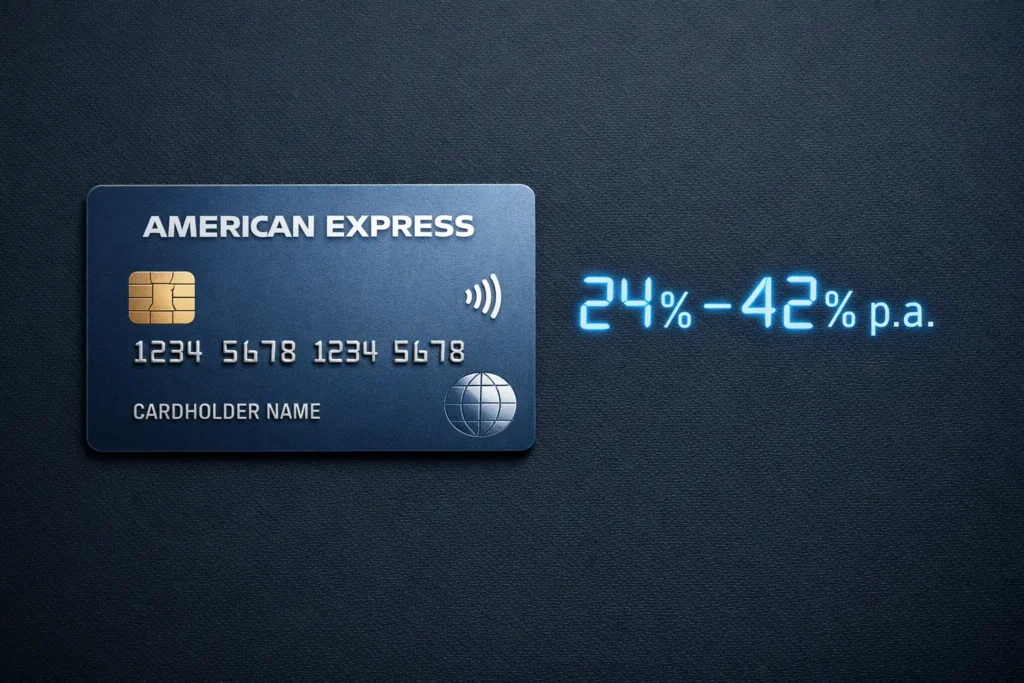
Quick Answer: In the USA, premium Amex cards (Platinum, Gold, Green) charge 0% foreign transaction fee. Standard cards charge up to 2.7%. In India, all Amex cards charge a 3.5% cross-currency markup on every international transaction. International cash advances carry no grace period and accrue interest from day one at up to 42% p.a.
Amex International Fees — USA Cards
American Express USA cards fall into two clear groups when it comes to international use: premium cards with no foreign transaction fee and standard cards charging up to 2.7% per transaction.
| Fee Type | Amount (USA) | When It Applies |
|---|---|---|
| Foreign Transaction Fee | 0% – 2.7% of transaction | Purchases in foreign currency or billed by foreign merchants |
| ATM Cash Advance (Abroad) | $10 or 5% — whichever is higher | Cash withdrawal at any international ATM |
| Cash Advance Interest | Up to 28.49% APR from day 1 | No grace period — interest starts immediately, no exceptions |
| Dynamic Currency Conversion | Merchant-set rate (often 3%–7% markup) | When a merchant offers to bill you in USD — always decline |
USA Cards with 0% Foreign Transaction Fee: Amex Platinum Card®, Amex Gold Card, Amex Green Card, Delta SkyMiles® Amex cards, Hilton Honors Amex cards, and Marriott Bonvoy Amex cards. Always confirm by checking your specific cardmember agreement or the Amex app before you travel.
Amex International Charges — India Cards
Unlike the USA where premium cards waive the foreign fee entirely, all Amex India credit cards charge a 3.5% cross-currency markup on international transactions — whether you’re physically travelling abroad or buying from an overseas merchant online from India.
| Fee Type | Amount (India) | Important Notes |
|---|---|---|
| Cross-Currency Markup | 3.5% of transaction value | Applies to all foreign currency transactions — online & offline |
| ATM Cash Advance (Abroad) | 2.5% or ₹500 — whichever is higher | Charged on top of the cross-currency markup |
| Cash Advance Interest | Up to 42% p.a. from transaction date | No grace period — most expensive charge on any Amex India card |
| Dynamic Currency Conversion | Merchant-variable — always avoid | Always choose to pay in local currency, not INR, when abroad |
⚠️ International ATM Cash Advance (India) — Real Cost: Withdrawing the equivalent of ₹20,000 abroad costs you: (1) ₹500 flat fee, (2) ₹700 cross-currency markup (3.5%), AND (3) interest at 42% p.a. from the exact day of withdrawal with zero grace period. That single ₹20,000 withdrawal can cost over ₹1,200 in fees and interest in the first month alone — before any principal repayment.
Amex vs Visa vs Mastercard: International Fee Comparison
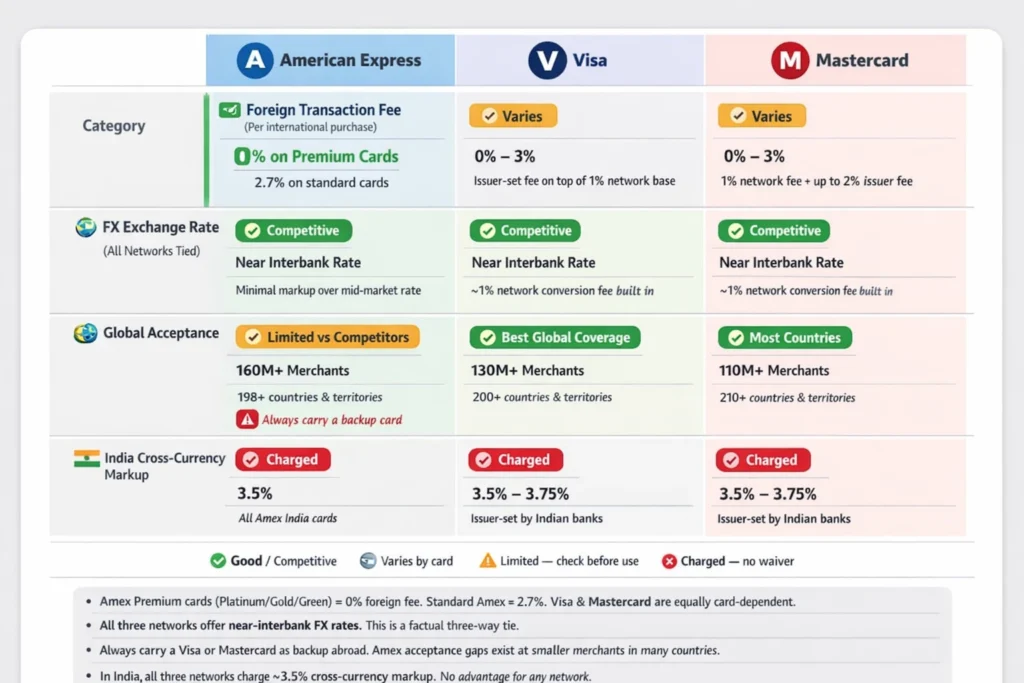
| Fee Type | American Express | Visa (Standard) | Mastercard (Standard) |
|---|---|---|---|
| Foreign Transaction Fee (USA) | 0% (premium) / 2.7% (standard) | 1%–3% (issuer-set) | 1%–3% (issuer-set) |
| Cross-Currency Markup (India) | 3.5% | 3.5%–3.75% | 3.5%–3.75% |
| ATM Cash Advance (Abroad) | $10/5% (USA) | 2.5%/₹500 (India) | Issuer-dependent |
| Global Merchant Acceptance | Good (major cities, premium merchants) | Excellent globally | Excellent globally |
| FX Rate Quality | Competitive (near interbank rate) | Competitive | Competitive |
Key takeaway: On international fees, Amex’s premium USA cards are genuinely competitive — often better than standard Visa/Mastercard cards at the same banks. In India, the 3.5% markup is in line with the market. However, Amex’s global merchant acceptance remains narrower than Visa and Mastercard — particularly at smaller merchants, budget accommodation, local markets, and in many developing countries. Always carry a backup card when travelling internationally.
Dynamic Currency Conversion — Always Decline
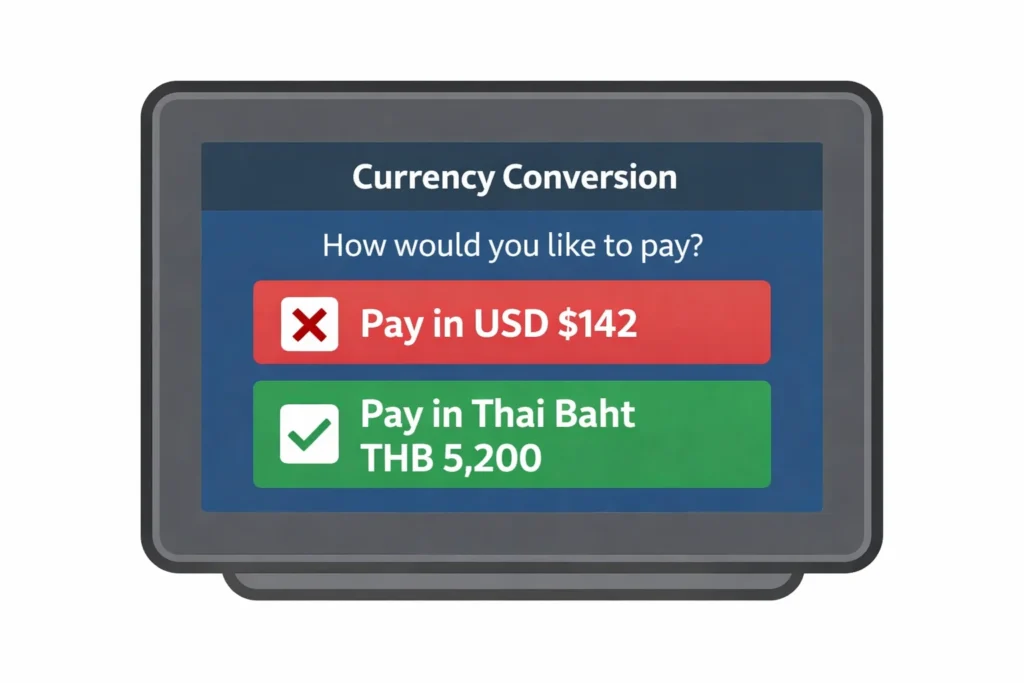
Dynamic Currency Conversion (DCC) is when a foreign merchant, hotel, or ATM offers to process your transaction in your home currency (USD or INR) rather than the local currency of the country you’re in.
You should always, without exception, decline DCC.
Here’s why: the exchange rate used by the merchant for DCC is almost always 3%–7% worse than the rate American Express applies when converting the local currency charge. By accepting DCC, you’re paying both the merchant’s inflated rate AND potentially your card’s foreign transaction fee.
How DCC appears in practice:
- An ATM in Thailand asks: “Would you like to be charged in USD ($142) or Thai Baht (THB 5,200)?” — Always choose Thai Baht
- A hotel in Paris offers to process your bill in INR — Always choose Euros
- A restaurant’s card terminal shows you the INR equivalent and asks to confirm — Decline and pay in local currency
Simple rule: When given a choice of currency, always pay in the local currency of the country you’re in. Your Amex card will convert it at a far better rate than any merchant’s DCC system.
How International Purchases Affect Your EMI Eligibility
This is a critical point that most international travel guides miss entirely — and it matters for Indian cardholders in particular.
India: EMI Eligibility on International Transactions
- Indian Rupee transactions at Indian merchants: Fully EMI-eligible through the standard Amex India process
- Foreign currency transactions (converted to INR on statement): EMI eligibility depends on the merchant category code and Amex India’s approval — not guaranteed
- Cross-border e-commerce (e.g., Amazon US billed in USD): May not be eligible for standard EMI conversion plans
- No-Cost EMI: Almost exclusively restricted to partner Indian merchants — international transactions are typically excluded
After a large international purchase posts to your statement in INR, check the Amex India app or website for EMI conversion eligibility. If it doesn’t appear as eligible, you may be looking at carrying it as a revolving balance at 36%–42% p.a.
USA: Plan It™ on International Purchases
Amex USA’s Plan It™ feature is available on many eligible purchases, including some international ones. Eligibility is determined per transaction — look for the Plan It offer appearing in your Amex app after the transaction posts to your account.
🧮 Planning a large international purchase? Use the Amex EMI Calculator → to estimate your EMI or revolving interest cost before you commit to the purchase — so you know exactly what you’re getting into.
How to Minimise Your Amex International Charges
🇺🇸 For USA Cardholders
1. Use the right card: Travel with an Amex Platinum, Gold, or Green — all have 0% foreign transaction fees. If you don’t have one, consider a co-branded travel Amex card before your next trip.
2. Never accept DCC: Always pay in local currency when abroad. The choice appears at most terminals and ATMs — always select the local currency option.
3. Avoid ATM cash withdrawals: Amex cash advances abroad accrue interest at your full cash advance APR from day one, plus the transaction fee. Use a dedicated travel debit card or forex card for cash abroad instead.
4. Notify Amex before travel: While fraud detection has improved significantly, letting Amex know your travel dates and destinations via the Amex app can prevent unexpected card declines abroad.
🇮🇳 For India Cardholders
1. Always pay in local currency: Never accept DCC — the 3.5% cross-currency markup is bad enough; adding a merchant’s DCC surcharge on top makes it far worse.
2. Use a forex card for ATM cash abroad: The combination of the 2.5%/₹500 fee plus 42% p.a. interest from day one makes Amex India cards among the most expensive ways possible to access cash internationally.
3. Track international spend separately: The 3.5% markup meaningfully increases your effective cost on large foreign purchases. A ₹1,00,000 international transaction costs ₹3,500 extra before your card even processes it.
4. Check EMI eligibility post-travel: After large international purchases post to your statement in INR, check the Amex app immediately for EMI conversion availability. Converting to EMI (if eligible) at ~15% p.a. is far better than revolving at 36%–42% p.a.
Does American Express charge a foreign transaction fee?
How much does Amex charge for international ATM withdrawals in India?
Is American Express widely accepted internationally?
What is Dynamic Currency Conversion and should I use it?
Can I convert my international Amex purchase to EMI (India)?
📌 Related Reading: American Express Interest Rate Guide (USA & India) | Is Amex Interest Free? Grace Period Explained | Amex EMI Calculator — Free Tool
Disclaimer: Fees and charges are indicative and subject to change. Always verify current charges on AmericanExpress.com or your card statement before travelling. This article is for informational purposes only.
Source – American Express

Mayank Srivastava is a Indian Stock Market Expert with over 2+ years of experience in financial markets and investment analysis. He specializes in IPO evaluations, grey market premium tracking,various stock market strategies, derivatives strategies and data-driven investment research.
His analysis has helped thousands of retail investors make informed decisions in the Indian primary market. Mayank holds advanced certifications in financial Market and regularly contributes to leading financial publications. But he is not SEBI registered Finance Professional. He writes only for educational purpose not giving any investment advice. Please Consult SEBI Registered Finance Consultant or Professional before any investment in stock market. He is not responsible any investment loss after reading this website content