The pharmaceutical industry runs on precision, scale, and trust. Among the companies that have mastered this balance, Sun Pharmaceutical Industries stands out.
But what really drives its growth?
If you strip away the complex drug names and regulatory jargon, Sun Pharma’s business model is surprisingly structured—and quite smart. It blends high-volume generics with high-margin specialty drugs, while expanding globally.
Let’s break it down in a clear, practical way.
Read Also – How a Sun Pharma Organon Deal Could Impact Global Pharma Stocks
What Does Sun Pharma Actually Do?
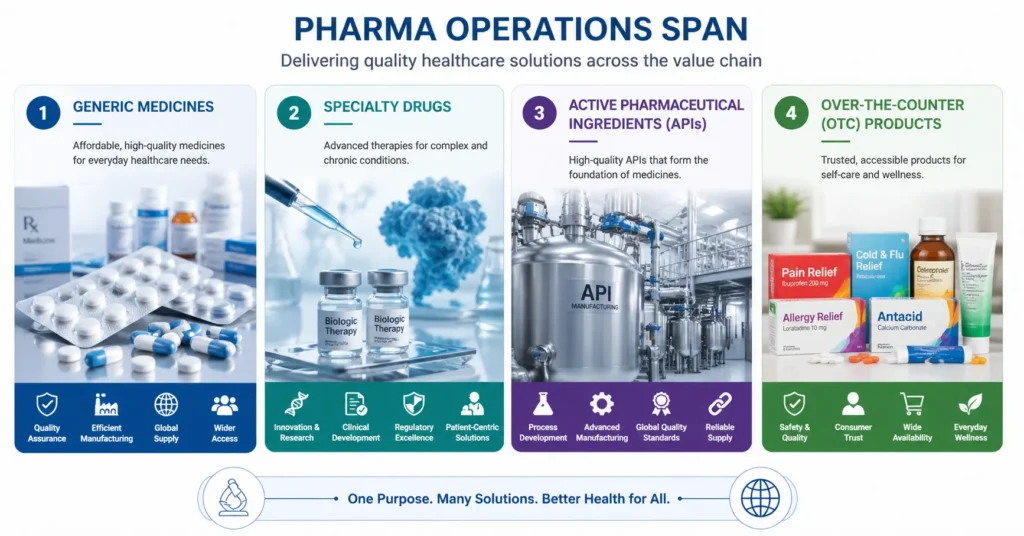
At its core, Sun Pharma develops, manufactures, and sells pharmaceutical products across multiple segments.
The company operates in 100+ countries, with a strong presence in India and the United States.
According to company filings and investor presentations, the U.S. contributes a significant share of revenue, followed by India and other emerging markets.
The Core of Sun Pharma’s Business Model
Sun Pharma doesn’t rely on a single revenue stream. Instead, it follows a multi-layered model.
1. Generics Business (High Volume, Competitive Pricing)
Generics form the foundation.
These are medicines that replicate branded drugs after patent expiry.
Why this matters:
- Lower development cost
- Faster market entry
- High demand globally
But there’s a catch—competition is intense. Prices often drop quickly.
So while generics bring volume, they don’t always bring high margins.
2. Specialty Drugs (High Margin, Long-Term Play)
This is where things get interesting.
Sun Pharma has invested heavily in specialty drugs, especially in:
- Dermatology
- Ophthalmology
- Oncology
These products offer:
- Better pricing power
- Brand differentiation
- Higher margins
Think of generics as the steady engine, and specialty drugs as the turbo boost.
3. API Manufacturing (Backward Integration)
Sun Pharma produces many of its own active pharmaceutical ingredients (APIs).
Why this is important:
- Reduces dependency on external suppliers
- Improves cost control
- Enhances supply chain stability
This strategy became especially valuable during global supply disruptions.
4. Global Distribution Network
Sun Pharma doesn’t just manufacture—it distributes globally.
Key markets include:
- United States
- India
- Emerging markets (Asia, Africa, Latin America)
This diversification reduces reliance on a single geography.
Revenue Streams Explained
Let’s simplify how Sun Pharma earns money:
✔ U.S. Market
- Specialty drugs + generics
- High regulatory standards
- Strong revenue contributor
✔ India Market
- Branded generics
- Strong doctor relationships
- Consistent growth
✔ Emerging Markets
- Volume-driven growth
- Expanding healthcare access
According to financial disclosures, this diversified revenue mix helps balance risk.
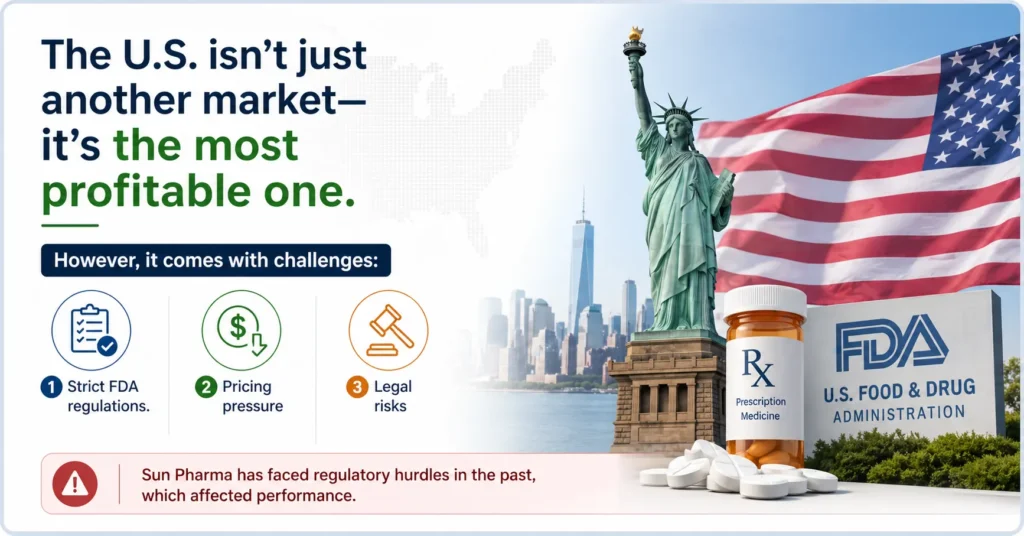
Why the U.S. Market Matters So Much
Research & Development Strategy
Innovation plays a key role.
Sun Pharma invests in R&D to:
- Develop specialty drugs
- Improve formulations
- Expand its pipeline
Unlike big pharma giants, it doesn’t focus heavily on new molecule discovery. Instead, it focuses on complex generics and specialty innovation.
This approach reduces risk while maintaining growth potential.
Cost Efficiency & Scale Advantage
Scale is one of Sun Pharma’s biggest strengths.
It operates multiple manufacturing facilities across the globe.
Benefits include:
- Lower production costs
- Better pricing flexibility
- Higher margins over time
In simple terms, producing more at lower cost gives it a competitive edge.
Strategic Acquisitions & Expansion

Competitive Position in the Industry
Sun Pharma competes with both Indian and global players.
Key Competitors:
- Cipla Limited
- Dr. Reddy’s Laboratories
- Pfizer Inc.
Each has its own strengths.
Sun Pharma differentiates itself through:
- Strong specialty focus
- Global reach
- Balanced portfolio
Risks in Sun Pharma’s Business Model
No business model is perfect.
Here are key risks:
1. Regulatory Challenges
The U.S. FDA maintains strict standards. Any compliance issue can impact operations.
2. Pricing Pressure
Generic drug prices often decline due to competition.
3. Dependence on Key Markets
Heavy reliance on the U.S. can create volatility.
4. Execution Risks in Specialty Segment
Specialty drugs require strong marketing and clinical success.
What Makes Sun Pharma’s Model Sustainable?
Despite challenges, the model shows resilience.
✔ Diversification
Multiple revenue streams reduce risk.
✔ Focus on High-Margin Segments
Specialty drugs improve profitability.
✔ Global Presence
Wide market reach supports growth.
✔ Operational Efficiency
Scale keeps costs under control.
A Quick Reality Check
Let’s keep things grounded.
Sun Pharma isn’t perfect. No pharma company is.
Stock performance can fluctuate due to:
- Regulatory news
- Market sentiment
- Earnings results
So while the business model is strong, outcomes depend on execution.
1. Is Sun Pharma a good company?
2. Which company is better, Cipla or Sun Pharma?
3. Why is Sun Pharma falling?
4. Which is better Sun Pharma or Dr Reddy?
5. Who are the big 3 Pharma companies?
6. What is Sun Pharma Stock Price?
7. Why sun pharma share price is falling?
Final Thoughts
The Sun Pharma business model works because it balances:
- Volume (generics)
- Profitability (specialty drugs)
- Stability (diversified markets)
That combination helps it stay competitive in a complex industry.
If you’re analyzing pharma stocks or industry trends, understanding this model gives you a strong foundation.
Because in pharma, success doesn’t come from one blockbuster—it comes from a system that keeps delivering.
Sources & Editorial Transparency
This article is based on:
- Company annual reports and investor presentations
- Industry insights from IQVIA
- Coverage from Reuters and Bloomberg
All information has been presented with a focus on accuracy and clarity, without speculative claims.

Written by
Mayank Srivastava
Finance Niche Writer, AI Content Writer
Mayank Srivastava is a Finance Content, AI Tools & Tech Content with over 6+ years of experience in tech, AI, and 2+ Years of experience in financial markets and investment analysis. He research in IPO evaluations, grey market premium tracking,various stock market strategies, derivatives strategies and data-driven investment research.
Mayank holds advanced certifications in financial Market and regularly contributes to leading financial publications. But he is not SEBI registered Finance Professional. He writes only for educational purpose not giving any investment advice. Please Consult SEBI Registered Finance Consultant or Professional before any investment in stock market. He is not responsible any investment loss after reading this website content.